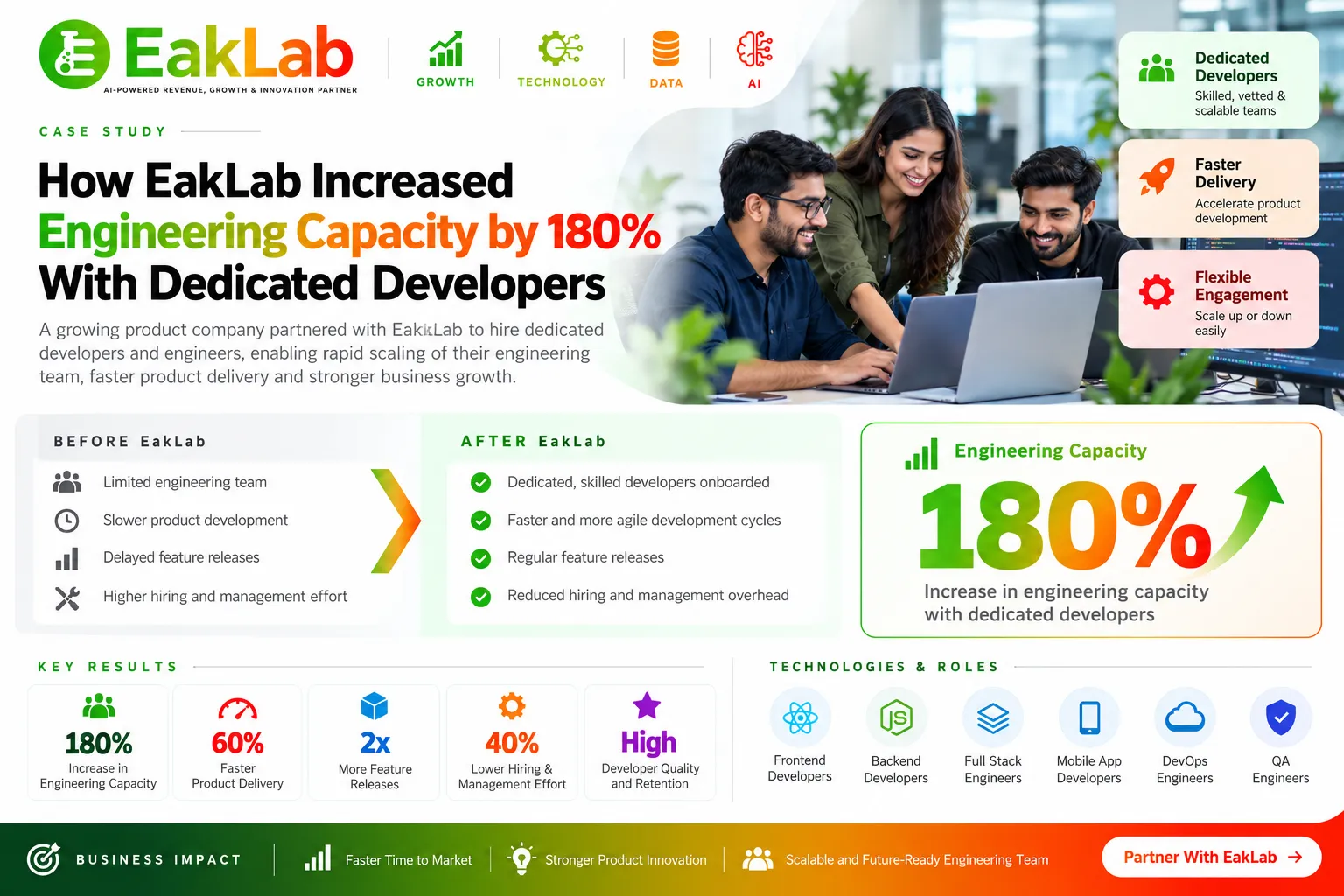

How EakLab Increased Engineering Capacity by 180% With Dedicated Developers
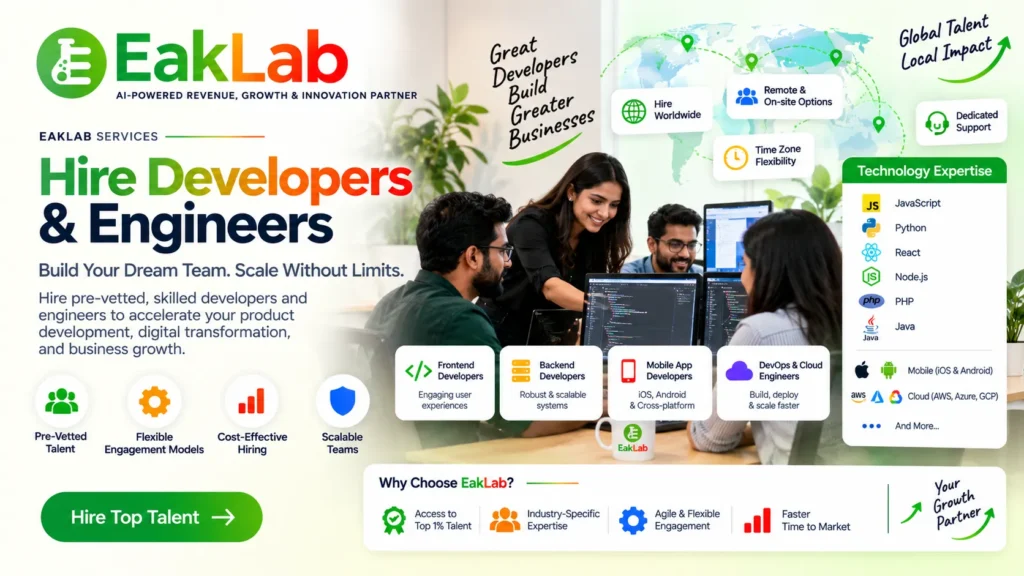
EakLab helped a growing SaaS company expand its engineering capabilities through a dedicated, on-demand team of developers and engineers. The engagement focused on increasing development capacity, accelerating feature delivery, reducing the development backlog and maintaining engineering quality.
By providing specialized technical resources aligned with the client’s roadmap, EakLab enabled the organization to scale its engineering team without relying exclusively on lengthy traditional recruitment cycles.
About the Client
The client was a growing SaaS and technology company serving customers across multiple markets. As its product roadmap expanded, the organization needed additional engineering capacity to deliver new features, maintain existing systems and respond to evolving business requirements.
Hiring for every new technical requirement through traditional recruitment could slow delivery and make it difficult to scale the team in line with project priorities.
The organization needed a flexible resourcing model that provided specialized developers and engineers who could collaborate with internal teams, work within established development processes and support ongoing product delivery.
EakLab provided a dedicated and on-demand engineering team designed to help the client expand technical capacity while maintaining flexibility around its roadmap.
The Challenge
As the company’s product and engineering requirements grew, several challenges affected development speed and team capacity.
1. Limited Engineering Capacity
The internal team needed additional resources to manage an expanding product roadmap.
2. Slow Resource Deployment
Traditional recruitment cycles made it difficult to add technical talent quickly.
3. Growing Development Backlog
Feature requests, technical improvements and maintenance work competed for limited engineering resources.
4. Delayed Feature Delivery
Insufficient capacity affected the pace at which product improvements could be released.
5. Specialized Skill Requirements
The organization needed expertise across frontend, backend, full-stack development, DevOps, QA and data engineering.
6. Engineering Quality
Increasing development velocity needed to be balanced with testing, code quality and production reliability.
7. Flexible Scaling
The business required a way to expand engineering capacity as priorities and workloads changed.
The EakLab Solution
EakLab implemented a dedicated and on-demand engineering model to provide additional technical expertise aligned with the client’s development priorities.
Dedicated Engineering Resources
Deployed a team of 18 engineers across relevant technical areas to expand capacity around the product roadmap.
Multiple Technical Specializations
Covered full-stack development, backend engineering, frontend development, DevOps, quality assurance and data engineering.
Agile Development Collaboration
Supported collaboration with internal teams within existing sprint planning, backlog management, code review and release processes.
Flexible Resource Deployment
Aligned engineering resources with project requirements and development priorities, reducing dependence on lengthy recruitment cycles.
Engineering Quality & Testing
Supported development speed with testing, code review and structured release processes.
Scalable Team Structure
Provided a foundation for adjusting engineering capacity as product requirements, workloads and business priorities evolved.
Implementation & Execution
Phase 1 — Engineering Requirement Assessment
Reviewed the product roadmap, engineering backlog, technology stack, skill requirements and delivery priorities to identify where additional expertise could contribute most effectively.
Phase 2 — Technical Skill Mapping
Mapped resource needs across frontend, backend, full-stack, DevOps, QA and data engineering to align skills with development requirements.
Phase 3 — Dedicated Team Deployment
Assigned engineers according to required capabilities and project priorities, expanding technical capacity without depending entirely on individual recruitment cycles.
Phase 4 — Agile Workflow Integration
Aligned the engineering team with sprint planning, task prioritization, backlog management and code reviews.
Phase 5 — Product Development & Delivery
Supported feature development, technical improvements and ongoing engineering work to progress the product roadmap.
Phase 6 — Quality Assurance
Used testing and engineering quality practices to validate functionality and reduce the risk of defects reaching production.
Phase 7 — Performance & Delivery Monitoring
Evaluated sprint completion, feature releases, backlog levels and production defects as delivery-related indicators.
Phase 8 — Flexible Scaling
Supported changes in engineering requirements as product priorities and workloads evolved.
Results: Measurable Engineering Growth
The reference metrics provided in the EakLab PDF report the following outcomes.
Engineering Capacity
Expanded technical capacity
Product Releases
More product releases
Feature Delivery
Accelerated delivery
Resource Deployment
Faster team deployment
Development Backlog
Reduced pending work
Sprint Completion
Reported completion
Production Defects
Quality-focused delivery
Dedicated Engineers
Engineers deployed
Performance Impact at a Glance
| KPI | Reported Outcome |
|---|---|
| Engineering capacity | +180% |
| Product releases | +138% |
| Feature delivery | 39% faster |
| Resource deployment | 78% faster |
| Development backlog | 57% lower |
| Sprint completion | 93% |
| Production defects | 57% fewer |
| Dedicated engineering team | 18 engineers |
Business Outcomes
Greater Engineering Capacity
The dedicated team model expanded engineering resources to support more development work and evolving product requirements.
Faster Feature Delivery
The reference case reports 39% faster feature delivery, helping product improvements move through development more quickly.
Reduced Development Backlog
The reported 57% reduction in backlog indicates improved capacity to address pending development requirements.
Faster Resource Deployment
The reported 78% improvement highlights the potential advantage of flexible engineering resourcing over lengthy recruitment cycles.
Improved Sprint Completion
A reported sprint completion rate of 93% reflects stronger delivery against planned sprint work in the reference scenario.
Fewer Production Defects
The reference case reports 57% fewer production defects, emphasizing quality alongside development speed.
Flexible Scaling
The engagement provided access to a broader range of technical skills, allowing resources to align with changing project needs.
Business Value
Product Development
Additional capacity to address features, improvements and roadmap priorities.
Engineering Operations
Better alignment between technical resources and development requirements.
Delivery
Greater ability to manage sprints, backlogs and releases.
Quality
Continued focus on testing, code review and production reliability.
Flexibility
Access to specialized developers without relying exclusively on permanent internal hiring.
Growth
A more adaptable engineering model that can evolve with the product and business.
The key benefit is the ability to match engineering capacity with actual product requirements while maintaining a structured development process.
Why EakLab for Hire Developers & Engineers?
Flexible Engagement
Scale engineering capacity according to project requirements, priorities and development stages.
Multiple Technical Skills
Access developers across frontend, backend, full-stack, DevOps, QA, cloud and data engineering.
Faster Team Deployment
Add engineering capacity without waiting through lengthy traditional recruitment cycles.
Extension of Your Team
EakLab engineers can collaborate directly with internal product and technology teams.
Agile Development
Teams can work within existing sprint planning, backlog, code review and release processes.
Long-Term Scalability
Start with a focused team and expand engineering capacity as the product roadmap grows.
Growth + Technology + Data + AI
EakLab combines Growth, Technology, Data and AI capabilities to support broader digital transformation initiatives.
Related Posts: