![EakLab [Official]](https://www.eaklab.com/wp-content/uploads/2026/09/EakLab-Logo-Latest.png)
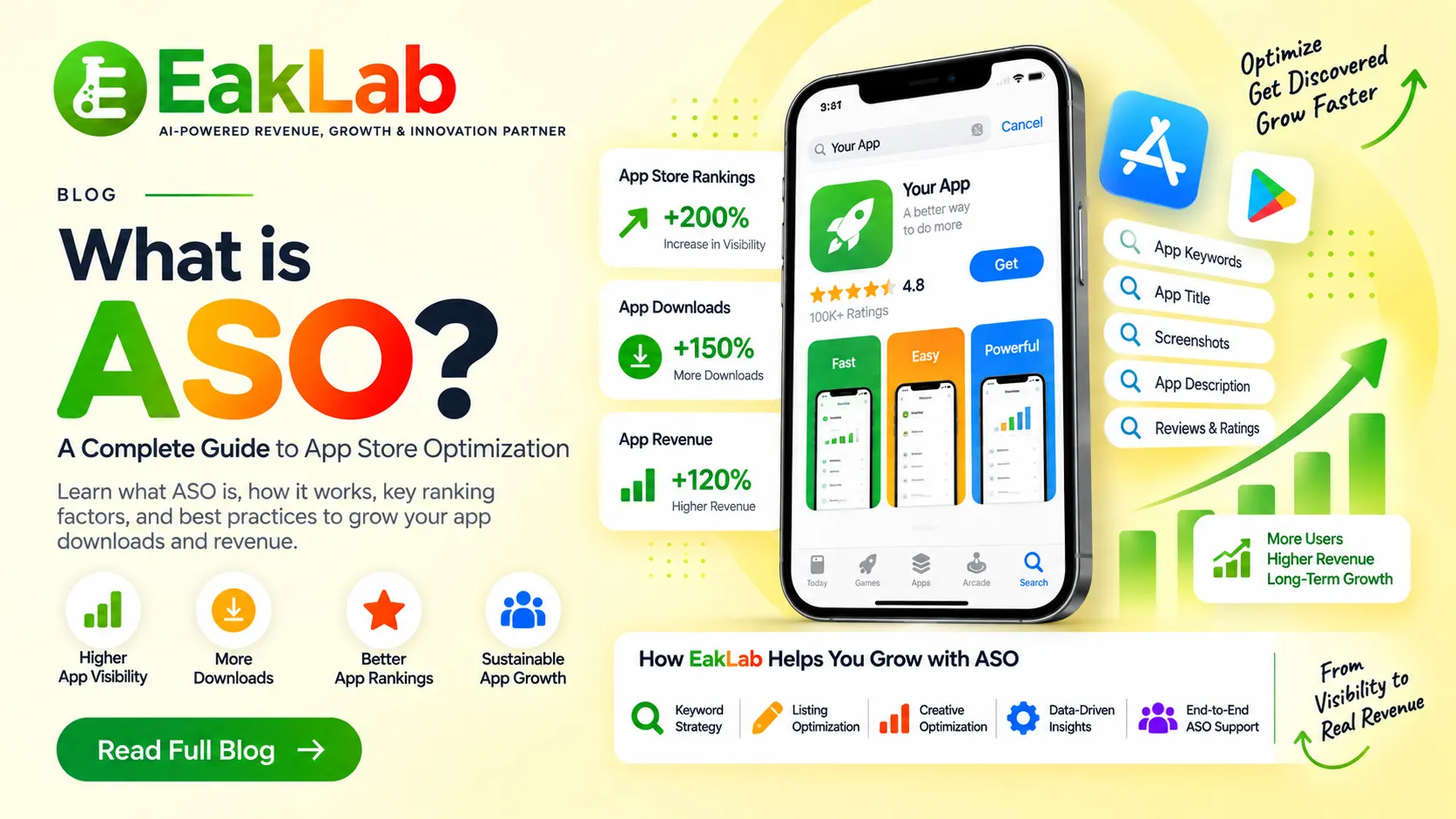

What Is ASO? App Store Optimisation Explained
Introduction to ASO (App Store Optimization)
App Store Optimization (ASO) is the process of improving a mobile app’s organic position (also known as visibility) in the app stores with an aim to increase the number of downloads, installs and further user engagement. ASO is very similar to Search Engine Optimization that is applicable for websites. ASO’s main focus is on optimizing all the essential elements of a mobile application listing to rank on the top position in the app store search results and increase more users who have the potential to buy the company services/products in the future.
Why ASO Matters
In the modern digital ecosystem where millions of apps are competing with each other to gain top position, the importance of ASO increases multiple folds. The right set of ASO marketing approaches helps a business to stand out from its competitors & achieve further success. Effective ASO can lead to:-
-
Increased Visibility: The top position in app store search results make your app more discoverable by potential users.
-
Higher Conversion Rates: Optimized app listings attract more users and increase the app downloads percentage.
-
Cost-Effective Marketing: Unlike paid advertising, ASO provides a cost-efficient way to grow your app’s user base.
-
Improved User Experience: Optimization of apps includes changing some of the important app elements that further result in better overall user experience.
Key Components of ASO
Some of the necessary components that define the success of a ASO campaign are listed below:-
-
App Title and Keywords: Create a catchy, unique, relevant title and select the relevant keywords to improve the searchability.
-
App Description: Writing a clear and attractive description that highlights your mobile app’s features and benefits.
-
App Icon: Designing an eye-catching icon that represents the app’s identity.
-
Screenshots and Videos: Showcasing the app’s functionality and user interface using the help of professional visuals.
-
App Reviews and Ratings: Manage and get positive reviews to build user trust and credibility towards your mobile app.
-
App Updates: Regularly updating the app to improve features, fix bugs, and maintain relevance according to latest trends.
-
Localization: Change the app listing to different languages and cultures to reach a global audience that helps in scaling of business and growth.
The Importance of ASO
App Store Optimization is not merely about achieving higher rankings; it’s about driving meaningful engagement and fostering long-term growth. Here’s why ASO is indispensable for app developers and marketers:
1. Enhanced Visibility
With millions of apps available across app stores like Apple’s App Store and Google Play, standing out is a significant challenge. ASO ensures that your app is visible to the right audience by improving its ranking in search results and featured sections. Increased visibility directly correlates with higher download rates and user acquisition.
2. Higher Conversion Rates
An optimized app listing not only attracts more users but also converts visits into downloads. Elements like a compelling app title, persuasive description, attractive screenshots, and positive reviews play a crucial role in convincing users to download your app. Higher conversion rates mean that your marketing efforts are more effective, yielding better returns on investment.
3. Cost-Effective Marketing
Unlike paid advertising, which requires continuous investment, ASO provides a sustainable growth model. By focusing on organic growth through optimized listings, you can achieve long-term success without the need for substantial advertising budgets. This makes ASO an attractive option for startups and small businesses with limited marketing resources.
4. Improved User Experience
ASO often involves refining various elements of the app and its listing, which can enhance the overall user experience. By addressing issues like app performance, design, and functionality, you not only improve rankings but also ensure that users have a positive experience, leading to higher retention rates and better reviews.
5. Competitive Advantage
In a saturated market, having a well-optimized app can give you a competitive edge. ASO helps you understand what your competitors are doing, identify gaps in the market, and leverage opportunities to differentiate your app. This strategic advantage is crucial for gaining market share and establishing a strong brand presence.
Key Components of ASO
In order to properly optimize your app ranking in the app stores, it is important for you to properly understand all the essential components that directly affect the app visibility and attract potential customers. In the below section, I have listed all of them:-
App Title and Keywords
App Title and Keywords are the 2 most important elements of ASO. They play a vital role in figuring out how your app will appear in the app store listing results and how more users can install your app.
App Title
The app title is one of the first things which any user sees when browsing through the app store. It should include the below:-
-
Clear and Descriptive: It should accurately show how your app does.
-
Keyword-Rich: Include primary keywords without any type of extra overstuffing of phrases.
-
Branding: Include your brand name if possible. This will improve brand recognition and trust among the users.
-
Unique: Choose a unique name of the mobile app to stand out from competitors.
Example: Instead of a generic title like “Photo Editor,” use “PhotoMaster: Professional Photo Editing & Filters.”
Keywords
Keywords are the phrases/terms which users enter into the app store’s search bar. Some of the effective keyword optimization involves the below:-
-
Research: Identify relevant and high-traffic keywords using the help of professional popular tools like App Annie, Sensor Tower, or Google Keyword Planner.
-
Relevance: Choose keywords that are closely related to your app’s functionality and targeted audience.
-
Competition: Make a right balance between high-traffic & low-competition keywords to increase the chance of organic visibility in the app store.
-
Long-Tail Keywords: Include some of the specific phrases that take care of niche audiences and further reduce the competition.
Example: For a photo editing app, keywords could include “photo editor,” “image filters,” “professional photo tools,” and “photo effects.”
App Description
The app description is another important element that gives you the opportunity to motivate users to download your app. It should be:-
-
Engaging and Informative: Clearly explain what your app does, its key features, and how it benefits the user.
-
Keyword-Optimized: Organically integrate your relevant keywords to improve the overall searchability without doing any type of keyword stuffing.
-
Structured: Try to use some headings, bullet points, and short paragraphs to make the description easy to read for the user.
-
Call-to-Action (CTA): Add unique CTA like that encourage users to download, try, or purchase the app.
Example:
Transform your photos with PhotoMaster, the ultimate photo editing app designed for both beginners and professionals.
• Professional Filters: Apply stunning filters that enhance your photos instantly.
• Advanced Editing Tools: Crop, rotate, adjust brightness, contrast, and more with precision.
• Creative Effects: Add unique effects like blur, vignette, and color splash to make your photos stand out.
• Easy Sharing: Share your masterpieces directly to social media platforms with just a tap.
• User-Friendly Interface: Intuitive design that makes photo editing simple and enjoyable.Download PhotoMaster today and take your photo editing skills to the next level!
App Icon
The app icon is another critical visual element of a mobile application that directly impacts the app CTR (click-through-rate). An ideal app icon should include the below:-
-
Visually Appealing: Eye-catching design that should be unique and stands out in the app store.
-
Simple and Clear: Avoid any type of cluttering and only focus on a simple and memorable design that is easy to remember.
-
Relevant: Reflect your app’s purpose and functionality in a clear transparent manner.
-
Consistent with Branding: Use consistent brand color scheme and style in your app.
Screenshots and Videos
Screenshots and Videos provide a visual representation of your business app that include all the essential features and interactive user interface. It should be:-
-
High-Quality: You need to use clear and high-resolution images that accurately show your app’s functionality.
-
Descriptive: Also, highlight the main app features and benefits via captions or annotations.
-
Engaging: Use compelling visuals that capture the user’s interest and demonstrate the app’s value.
-
Varied: Try to include a variety of screenshots that show different aspects of the app. It includes proper navigation, key features, and user interactions.
App Reviews and Ratings
App Reviews and Ratings are another important element that plays an integral role in influencing the users decision to download your app in the app stores. This should include the below:-
-
Encouraging Positive Reviews: Ask your satisfied users to leave positive feedback about the app usage.
-
Responding to Reviews: Regularly engage with your users by responding to on time reviews, addressing concerns, and showing appreciation as per the requirements.
-
Monitoring Feedback: Monitor proper reviews to identify some of the most common issues and areas for improvement.
-
Maintaining High Ratings: Try to to maintain a high average rating by delivering a quality experience. Also addressing any negative feedback promptly helps in getting good experience.
App Updates
Regular App Updates are another major element that maintain proper relevance and also improve the overall user experience. It helps the user to know that the app is regularly maintained by the business according to change in trends and features requirements. An effective app updates should:
-
Introduce New Features: Add functionality that better the overall user experience.
-
Fix Bugs: Address any issues or glitches reported by users to make sure a proper hassle free performance.
-
Improve Performance: Optimize your mobile app speed and responsiveness equally.
-
Communicate Changes: Clearly explain what’s new in the update through regular release notes.
Localization
Localization consists of changing the app store listing to different languages and adding the relevant contexts. This helps you to reach a global audience for more business growth. Effective localization should include the below:-
-
Translate Content: Accurately translate your mobile app’s title, description, keywords, and other metadata.
-
Cultural Adaptation: Modify visuals, symbols, and content to align with local cultural norms and preferences.
-
Local Keywords: Add some region-specific keywords that improve the overall search ability in different languages.
-
Regional Relevance: Highlight features or content that match with local users’ demand.
Types of ASO
App Store Optimization can be categorized into different types based on the focus and methodologies used. Understanding these types helps in implementing a comprehensive ASO strategy.
On-Metadata ASO
On-Metadata ASO focuses on optimizing the elements within the app store listing itself. This includes:
-
App Title and Keywords: Optimizing the app’s name and incorporating relevant keywords.
-
App Description: Crafting a compelling and keyword-rich description.
-
App Icon: Designing an attractive and representative icon.
-
Screenshots and Videos: Using high-quality visuals to showcase the app.
-
App Reviews and Ratings: Managing and encouraging positive feedback.
Off-Metadata ASO
Off-Metadata ASO involves efforts outside the app store listing to improve app visibility and credibility. This includes:
-
App Backlinks: Building quality backlinks to your app’s store page from reputable websites.
-
Social Media Marketing: Promoting your app through social media channels to increase awareness and downloads.
-
Content Marketing: Creating valuable content such as blog posts, articles, and videos that highlight your app’s features and benefits.
-
Public Relations (PR): Engaging in PR activities to gain media coverage and endorsements.
-
Influencer Marketing: Collaborating with influencers to promote your app to their followers.
Technical ASO
Technical ASO focuses on the technical aspects of the app and its performance, which can indirectly impact its ranking and user satisfaction. This includes:
-
App Performance: Ensuring fast load times, smooth navigation, and minimal crashes.
-
App Size: Keeping the app’s file size manageable to encourage downloads.
-
Compatibility: Ensuring the app is compatible with various devices and operating systems.
-
Security: Implementing robust security measures to protect user data and prevent breaches.
ASO Strategies
Implementing effective ASO strategies is crucial for enhancing your app’s visibility, attracting more downloads, and fostering user engagement. Here are some proven ASO strategies to consider:
Keyword Research and Optimization
Keyword Research is the foundation of ASO. It involves identifying the most relevant and high-traffic keywords that potential users are searching for. Effective keyword optimization includes:
-
Identify Relevant Keywords: Use tools like App Annie, Sensor Tower, or Google Keyword Planner to find keywords relevant to your app’s functionality and target audience.
-
Analyze Competitors: Study the keywords your competitors are using and identify gaps or opportunities.
-
Long-Tail Keywords: Incorporate specific phrases that cater to niche audiences, reducing competition and increasing relevance.
-
Keyword Placement: Strategically place keywords in the app title, subtitle, and description to enhance searchability without keyword stuffing.
Example: A fitness app might use keywords like “workout tracker,” “fitness planner,” “exercise routines,” and “health app” to attract users searching for fitness-related tools.
Optimizing App Title and Subtitle
The App Title and Subtitle are critical elements for ASO, directly influencing both search rankings and user perception.
-
App Title: Should be clear, concise, and include primary keywords. It represents your app’s identity and functionality.
-
App Subtitle: Offers an opportunity to include additional keywords and highlight key features or benefits in a succinct manner.
Example:
-
Title: “FitLife: Workout Tracker & Fitness Planner”
-
Subtitle: “Personalized Exercise Routines | Track Your Progress”
Crafting an Engaging App Description
The App Description is your chance to persuade potential users to download your app. It should be:
-
Clear and Concise: Communicate your app’s purpose and benefits clearly.
-
Keyword-Rich: Naturally integrate relevant keywords to enhance searchability.
-
Structured: Use headings, bullet points, and short paragraphs to make it easy to read.
-
Persuasive: Highlight unique features, benefits, and value propositions that set your app apart.
Example:
Welcome to FitLife, your ultimate workout tracker and fitness planner! Whether you’re a beginner or a seasoned athlete, FitLife is designed to help you achieve your fitness goals with ease.
• Personalized Workout Plans: Tailor-made exercise routines based on your fitness level and objectives.
• Progress Tracking: Monitor your workouts, track your progress, and stay motivated.
• Nutrition Guides: Access healthy meal plans to complement your fitness regimen.
• Community Support: Connect with a community of fitness enthusiasts for support and inspiration.
• Seamless Integration: Sync your data with popular fitness devices and apps for a comprehensive view of your health.Download FitLife today and embark on your journey to a healthier, fitter you!
Designing a Compelling App Icon
The App Icon is a visual representation of your app and plays a significant role in attracting users. It should be:
-
Simple and Memorable: Avoid clutter and focus on a clean, recognizable design.
-
Reflective of App’s Purpose: Use symbols or imagery that convey the app’s functionality.
-
Consistent with Branding: Align with your overall brand identity, including color schemes and styles.
-
High-Quality Design: Ensure the icon looks professional and appealing on various devices and screen sizes.
Example: A meditation app might use a serene lotus flower icon with calming colors like blue and green to evoke a sense of peace and relaxation.
Utilizing High-Quality Screenshots and Videos
Screenshots and Videos are essential for showcasing your app’s features and user interface. They should be:
-
High-Resolution: Use clear, high-quality images and videos to make a strong visual impact.
-
Descriptive: Highlight key features and benefits through captions or annotations.
-
Sequential: Present a logical flow that guides users through the app’s functionality.
-
Engaging: Use visually appealing designs that capture the user’s interest and demonstrate the app’s value.
Example: A task management app might include screenshots showing the dashboard, task creation, project collaboration, and mobile interface, accompanied by a video that demonstrates how to use the app effectively.
Managing App Reviews and Ratings
App Reviews and Ratings significantly influence user decisions and app store rankings. Effective management involves:
-
Encouraging Positive Reviews: Prompt satisfied users to leave positive feedback through in-app prompts or follow-up emails.
-
Responding to Reviews: Engage with users by responding to reviews, addressing concerns, and showing appreciation for feedback.
-
Monitoring Feedback: Regularly monitor reviews to identify common issues, trends, and areas for improvement.
-
Improving Ratings: Focus on enhancing app quality and user experience to maintain and improve your average rating.
Example: After a positive app update, a photo editing app might prompt users with a message like, “Enjoying the new features? Leave us a rating and review!”
Regular App Updates
Frequent App Updates are crucial for maintaining relevance, improving functionality, and addressing user feedback. Effective app updates should:
-
Introduce New Features: Add functionalities that enhance the user experience and meet evolving user needs.
-
Fix Bugs: Address any issues or glitches reported by users to ensure smooth performance.
-
Improve Performance: Optimize app speed, responsiveness, and overall usability.
-
Communicate Changes: Clearly explain what’s new in the update through detailed release notes.
Example: A language learning app might release an update that includes new lessons, improved speech recognition, bug fixes, and enhanced user interface elements to provide a better learning experience.
Localization and Internationalization
Localization involves adapting your app store listing to different languages and cultural contexts, enabling you to reach a global audience. Effective localization should:
-
Translate Content: Accurately translate your app’s title, description, keywords, and other metadata.
-
Cultural Adaptation: Modify visuals, symbols, and content to align with local cultural norms and preferences.
-
Local Keywords: Incorporate region-specific keywords to enhance searchability in different languages.
-
Regional Relevance: Highlight features or content that resonate with local users.
Example: A travel app localizing its listing by translating the description into multiple languages, using culturally relevant imagery, and highlighting features tailored to different regions, such as local maps and travel guides.
Best Practices for ASO
To maximize the effectiveness of your App Store Optimization efforts, it’s important to follow best practices that ensure your app stands out and attracts the right audience. Here are some key best practices for ASO:
1. Understand Your Target Audience
Knowing who your target users are is fundamental to effective ASO. Understanding their needs, preferences, and behaviors allows you to tailor your app listing and marketing strategies accordingly.
-
Demographics: Age, gender, location, income level, education.
-
Psychographics: Interests, hobbies, lifestyle, values.
-
User Behavior: How users interact with similar apps, their pain points, and what motivates them to download and use apps.
Example: If your app is a productivity tool aimed at professionals, your ASO strategy should emphasize features like task management, integration with other professional tools, and data security.
2. Conduct Competitor Analysis
Analyzing your competitors can provide valuable insights into what works and what doesn’t in your app’s category. It helps you identify opportunities to differentiate your app and improve your ASO strategy.
-
Identify Top Competitors: Look for apps with high rankings and similar functionalities.
-
Analyze Their Listings: Examine their app titles, descriptions, keywords, icons, screenshots, and videos.
-
Assess Reviews and Ratings: Understand what users appreciate or dislike about competing apps.
-
Benchmark Performance: Compare your app’s performance metrics against competitors to identify areas for improvement.
Example: If a competitor’s app has high ratings for its user interface, ensure your app offers a similarly or more intuitive and visually appealing interface.
3. Optimize for Quality Score
App stores use algorithms to rank apps based on various factors, collectively referred to as the Quality Score. Optimizing for quality score involves enhancing elements that contribute to higher rankings.
-
Relevance: Ensure your app’s keywords, title, and description are highly relevant to what users are searching for.
-
Engagement: High user engagement metrics, such as downloads, active users, and positive reviews, contribute to a higher quality score.
-
User Experience: A smooth, bug-free user experience leads to better ratings and reviews, boosting your quality score.
-
Conversion Rate: A higher conversion rate from views to downloads signals to the app store that your app is valuable and relevant.
Example: Continuously monitor your app’s performance metrics and make necessary adjustments to improve engagement and conversion rates.
4. Use Negative Keywords
Negative keywords prevent your app from appearing in irrelevant searches, ensuring that your app is shown to users who are genuinely interested in its functionality.
-
Identify Irrelevant Keywords: Determine keywords that are related to your app but not directly relevant or lead to unqualified traffic.
-
Exclude Them: Use negative keywords in your app’s metadata to avoid appearing in irrelevant search results.
-
Refine Over Time: Regularly review search terms to identify and add new negative keywords as needed.
Example: If your fitness app is not intended for bodybuilding enthusiasts, add “bodybuilding” as a negative keyword to avoid showing up in those searches.
5. Leverage A/B Testing
A/B Testing allows you to experiment with different elements of your app listing to determine what resonates best with your audience. This iterative process helps optimize your app’s performance based on real user data.
-
Test Different Elements: Experiment with various app titles, descriptions, icons, screenshots, and videos.
-
Measure Performance: Track metrics like click-through rate (CTR), conversion rate, and user engagement for each variation.
-
Implement the Best Performers: Adopt the elements that perform best and continuously test new variations to keep improving.
Example: Test two different app icons to see which one attracts more clicks and downloads, then use the better-performing icon as your primary app icon.
6. Optimize for Mobile Devices
Since users will be accessing your app store listing on mobile devices, it’s crucial to ensure that all elements are optimized for mobile viewing.
-
Responsive Design: Ensure that images, screenshots, and videos are formatted correctly for different screen sizes and resolutions.
-
Fast Loading: Optimize media files to load quickly without compromising quality.
-
Readable Text: Use clear and legible fonts in descriptions and annotations within screenshots.
Example: Ensure that your app’s promotional video is optimized for mobile playback, with clear visuals and captions that are easily readable on smaller screens.
7. Maintain Consistent Branding
Consistent branding across your app listing helps build recognition and trust among users. It involves maintaining a uniform look and feel in your app’s visuals and messaging.
-
Brand Colors and Fonts: Use your brand’s color palette and typography consistently across the app icon, screenshots, and videos.
-
Logo Placement: Incorporate your logo in a consistent location within your app’s visuals.
-
Unified Messaging: Ensure that your app’s description, features, and benefits align with your overall brand voice and values.
Example: A fashion app might use stylish, modern fonts and a chic color scheme in its app icon, screenshots, and promotional video to reflect its trendy and sophisticated brand identity.
8. Monitor and Respond to Reviews
Engaging with user reviews not only helps in managing your app’s reputation but also provides valuable feedback for improvement.
-
Respond Promptly: Address both positive and negative reviews in a timely and professional manner.
-
Show Appreciation: Thank users for their positive feedback and express gratitude for their support.
-
Address Concerns: Acknowledge and resolve issues mentioned in negative reviews to demonstrate commitment to user satisfaction.
What is App Store Optimization (ASO)
Introduction
The effort that goes into the development of an app can go all in vain at once if it does get the user acknowledgment and enough downloads. Whenever a new app comes on the play store, the way an average user gets to know about it is either via strong marketing or app ranking.
Once the user searches for something on the Play Store, if he gets his desired app, he won’t even scroll down further. So, clearly, if you do not seek to advertise your app, you have to work on its app ranking. This is what app store optimization is all about.
You must have heard about SEO in digital marketing, well app store optimization (ASO) can be understood as SEO for apps. To know in-depth about ASO, read the article.
What is App Store Optimization (ASO)?
With millions of apps being listed on the Google play store and Apple store, it gets difficult to maintain the visibility of our respected apps and ensure conversions.
App store optimization means optimizing your listed app on the play store or apple store to upscale its ranking and bring it amongst the top listed apps. It will ensure that any potential user can easily get its sight on your listed app. As a result, it will reach more customers and get more downloads.
Significance of the App Store Optimization (ASO)
App store optimization holds the worth to make your app reach more and more customers and bring organic downloads. In addition, once the ASO has shown its magic, you start getting organic customer reviews and honest feedback.
It would help you understand the customer’s interest and plan your improvement further. Furthermore, the cost saving here is immense that would have otherwise gone into advertisement expenses, if not for ASO.
At times, ASO is synonymously used with SEO, which is utterly wrong. Even though they both focus on optimization, the very nature of both are severely at two different corners. While SEO (Search Engine optimization) is content optimization, its primary focus lies on content type, keywords, and linkages on the web.
However, ASO is the optimization of mobile apps on the play store, focusing only on the combination of keywords and their usage in titles and descriptions of apps.
A Comprehensive Guide to Performing App Store Optimization (ASO)
In order to bring the best results from conducting app store optimization, one has to follow every step and consider every aspect of it very delicately. According to us; the complete procedure can be broken down into the following pointers as listed below.
1) Keyword Research for ASO
The app store listing works as per an algorithm that pushes certain apps over the top of the list. So, accordingly, the user can discover the listed app with ease. Relevant keywords used at the right place is one such factor of the algorithm that improves the ranks of apps.
The keyword research begins with analyzing the data of your app’s category to sort out the relevant and high-volume keywords. In addition, initiate research on the high-ranking apps of the competitors.
Once you have an idea about the keywords that possess high-ranking potential and what your competitors are using, you can fill up the gaps by bridging the differences.
Seek what your competitors have missed and adapt to the keywords which have proven successful. Lastly, give a closer look at what your customers are saying in the feedback and reviews.
The customer review can give you an outlook on how the marketplace describes the app and which words would fit best. Finally, bifurcate the keywords that describe your app the best and finalize the relevant ones.
2) A Compelling App Title and Description
The decisive stage is where the app user makes up his mind whether to download the mobile app or skip it for the next one strongly depending upon what description it is offering.
The reason is at first glance, the app title and description is the only information source available. What a new user gets to know about the app is only through the app title and description.
So, a catchy and crisp app title and description is what can get you a new download. There are certain points that you shall consider while framing an eye-catchy description.
Firstly, an average user goes through several apps before finalizing unless the particular app has already received popular recognition. Anyways he is not willing to read long paragraphs.
So, keep the description short and in fact try to make them into pointers. Secondly, use language which is easy for a layman to understand.
Avoid using technical terminologies and keep it simple. Lastly, do not forget to add a call-to-action at the end. It will ensure that the user gets strongly persuaded to download the app.
3) Positive App Ratings and Reviews
A very important aspect of app store optimization is to maintain positive app ratings and appealing reviews. The visibility of your app is shuffled based on the ranking it holds.
Further, it’s only when the ranking is good that the user approaches your mobile & reads the reviews further to finally download the mobile app.
For positive and in-favor reviews, you will have to provide encouragement to the user to publish feedback. A user would do it only if it is easy for him to do so.
Accordingly, add feedback prompts along with reminders both in favor and against the app to ensure honest feedback.
However, just collecting reviews beneath the app description is not enough. You will have to make an effort by replying to each review, both positive and negative, signifying your concern about the app and the value of customers for you.
The customers will make a positive outlook on the app which leads to more organic downloads and higher ranking.
4) Leveraging App Localization
App localization means enhancing the reach of your mobile app in terms of demography. App localization involves an all rounder step to make your mobile app reach international customers.
Some might think it is a transition stage where all you have to do is translate the text so that foreign users can understand. But, no, the app localization has more to it.
An effort has to be made to completely change the way of explaining, from slang used to technical jargon. You have to customize the content as per the respective country.
So, instead of focusing on a particular country to rank your app, you have to adopt app localization. Conduct keyword research based on each area or country and plan the app details accordingly. This will make your mobile app more global, inclusive, and acceptable.
5) Visual attractions
The mantra to top the modern digital era is “ what is seen is sold”. It means if you can present your offering well enough to catch the user’s eye, your half job is done. So, while you seek to bring your app to the user’s attention, you have to make it look appealing by using graphics and media.
Before getting into the description, app images & graphics must soothe the user’s eyes. Use premium quality images, add screenshots, and most importantly focus on adopting a very attractive app icon.
You have to begin by finalizing an image that best suits your mobile app and inculcating the similar images along with screenshots of the insides of the app. In addition, you can also use appealing short-form videos for exemplifying the usage of the mobile app. Further, you have to keep the images updated and adapted to the custom review and feedback.
6) Update and track
Once you have published & optimized the mobile app to receive a sound ranking, you have to further maintain the position by ensuring constant user engagement. You have to avoid reaching any saturation point. The users can have a monotonous experience with the same app features.
So, they look for new updates and catchy amends. Even at the back-end algorithm, the app store pushes those apps which show frequent and quicker changes.
For this, you have to scan through each and every user feedback, select the relevant ones, and inculcate the issues resolved in the app update.
Not only does updating ensure existing user satisfaction but also attracts new consumers, giving an edge over the competition in the marketplace.
Furthermore, by regularly keeping up with how the app is functioning and what the users are missing, you are able to understand the trends in the market.
Once you understand the data, you can include new keywords in the descriptions and add images that represent the data-driven algorithm to ensure more downloads.
Conclusion
App store optimization works on several pillars simultaneously. From using the right appropriate keywords to writing the most appealing description. Every factor of ASO has to work upon to get organic results and maximum downloads. ASO has proven to be an ultimate encouragement for all those app developers who have given their time and energy into making an app. ASO has the potential to make your app become visible to the users and increase the rate of download.
Related Posts: