
How EakLab Reduced Manual Processes by 67% With Custom Software
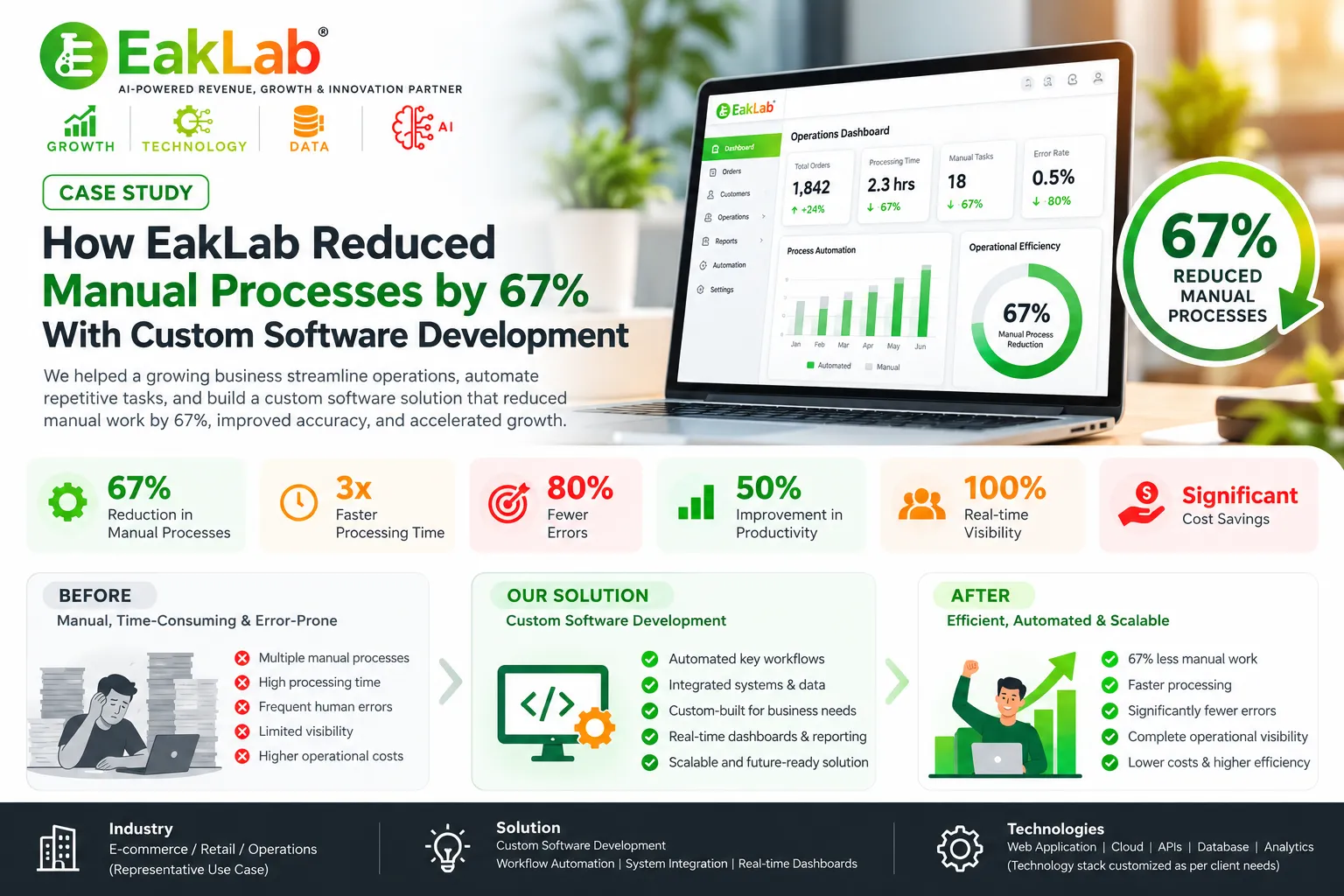
Transforming complex business processes into a centralized, scalable software platform designed around the client’s workflows, users, data and long-term technology requirements.
About the Client
The client was a B2B services and technology organization that needed a more structured way to manage its business operations. Its workflows involved manual activities, repetitive data entry, disconnected information and reporting processes that limited operational visibility.
The objective was to create a centralized custom software platform that could align with the organization’s existing business processes, reduce repetitive work, connect relevant systems and support increasing operational demands.
Rather than forcing the organization to adapt to the limitations of generic software, the solution focused on building functionality around its specific workflows and business requirements.
The Challenge
As business operations expanded, manual processes and fragmented workflows created challenges across productivity, data management and reporting.
1. Manual Operational Processes
Repetitive activities consumed time that teams could otherwise spend on higher-value work.
2. Disconnected Systems
Information was spread across applications and workflows, making coordination more difficult.
3. Repeated Data Entry
Manual information handling increased effort and the potential for errors.
4. Slow Reporting
Preparing operational reports required significant time and manual effort.
5. Limited Operational Visibility
Teams needed more centralized information to understand day-to-day performance.
6. Growing Processing Requirements
Existing processes made it difficult to increase capacity without increasing manual work.
7. Scalability Concerns
The organization required a technology foundation capable of supporting additional users and transactions.
The Solution
EakLab approached the project through business-process discovery, custom software development, workflow automation, system integration and operational optimization. The platform was designed around the client’s actual requirements, with a focus on simplifying workflows and creating a more connected operational environment.
Custom Workflow Management
Structured digital workflows replaced selected manual processes and helped teams follow more consistent operational procedures.
Centralized Data Management
Relevant business information was organized within a more connected environment to support access, coordination and reporting.
API & System Integration
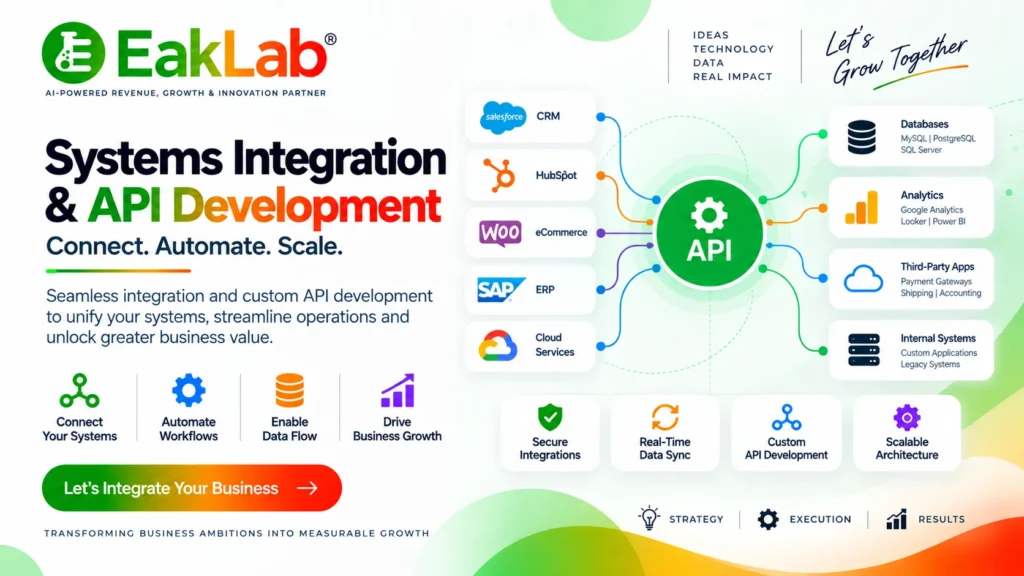
Integration capabilities connected relevant business applications and data flows, reducing fragmentation between operational activities.
Reporting & Operational Visibility
Centralized information and reporting helped management gain a clearer view of business activity and performance.
Scalable Software Architecture
The platform was designed to support growing user numbers, processing requirements and future operational needs.
Implementation & Execution
01 — Discovery & Requirement Analysis
Understand business processes, user roles, workflows, operational pain points and technology requirements.
02 — Solution Architecture
Define how software components, data structures and integrations work together with scalability and maintainability in mind.
03 — UX/UI Design
Structure user experiences around daily employee tasks and reduce unnecessary workflow complexity.
04 — Custom Development
Build software components around defined business logic and functional requirements.
05 — Integration & Automation
Connect relevant systems and convert suitable repetitive processes into structured digital workflows.
06 — Testing & Quality Assurance
Validate functionality, security, performance and end-to-end workflows before deployment.
07 — Deployment
Introduce the platform into the client’s operational environment for teams to use.
08 — Optimization & Support
Improve functionality, performance, automation and scalability as operational requirements evolve.
Results & Performance Improvements
67%
Fewer Manual Processes
Reduced reliance on manual operational work.
64%
Faster Processing
Less time required to process transactions.
68%
Less Manual Data Entry
Lower repetitive data-handling effort.
82%
Workflow Automation
A greater proportion of workflows automated.
161%
Higher Processing Capacity
Increased capacity to handle operational demand.
72%
Fewer Operational Errors
Process-related errors reduced.
93%
Faster Reporting
Less time needed to generate reports.
1,200+
Active Users
Platform usage at the reported scale.
| Metric | Before | After |
|---|---|---|
|
Transaction Processing Time
|
42 minutes | 15 minutes |
|
Process-Related Error Rate
|
7.4% | 2.1% |
|
Report Generation Time
|
6 hours | Approximately 25 minutes |
|
Active Users
|
Approximately 420 | More than 1,200 |
Business Value
More Efficient Operations
More structured processes and less repetitive manual work help teams manage routine activities more efficiently.
Employee Productivity
Reduced manual effort can free up more time for higher-value activities.
Improved Operational Visibility
Centralized operational data and reporting provide management with clearer performance information.
Connected Technology
A more integrated and maintainable software foundation helps reduce fragmentation across business systems.
More Consistent Service
More structured workflows can support faster processing and more consistent customer service.
Capacity for Growth
Greater processing capacity can help handle additional operational demand without proportionally increasing manual effort.
Performance at a Glance
Business Value & Productivity Potential
Using the reference figures in the provided case-study document.
| Metric | Calculation | Result |
|---|---|---|
| Time Saved per Transaction | 42 minutes − 15 minutes | 27 minutes |
| Reference Monthly Transaction Volume | As provided | 47,000 transactions |
| Calculated Time Saved | 47,000 × 27 minutes | 1,269,000 minutes |
| Equivalent Time | 1,269,000 ÷ 60 | Approximately 21,150 hours/month |
EakLab’s Custom Software Development Framework
01 — Discovery & Requirement Analysis
Understand business processes, users, workflows, pain points and technology requirements.
02 — Solution Architecture
Design software architecture, data models, integrations and scalability requirements.
03 — UX/UI Design
Build intuitive interfaces around real user workflows and business processes.
04 — Custom Development
Develop the required frontend, backend, databases, APIs and business logic.
05 — Integration & Automation
Connect relevant systems and automate repetitive activities.
06 — Testing & Quality Assurance
Validate functionality, performance, security and end-to-end workflows.
07 — Deployment
Launch the platform within the client’s operational environment.
08 — Optimization & Support
Improve functionality, performance, automation and scalability over time.
Why EakLab for Custom Software Development?
Software Built Around Your Business
Develop software around specific workflows instead of forcing the organization into generic tools.
End-to-End Development
Address discovery, architecture, development, integration, deployment and ongoing optimization.
Workflow Automation
Convert suitable manual and repetitive processes into structured digital workflows.
API & System Integration
Connect CRMs, databases, payment systems, internal applications and third-party platforms where required.
Scalable Architecture
Build a technology foundation designed to accommodate additional users, transactions, modules and integrations.
Data & Analytics
Use centralized data and reporting to improve visibility into operational performance.
Growth + Technology + Data + AI
EakLab combines Growth, Technology, Data and AI capabilities to support broader digital transformation objectives.
Related Posts: