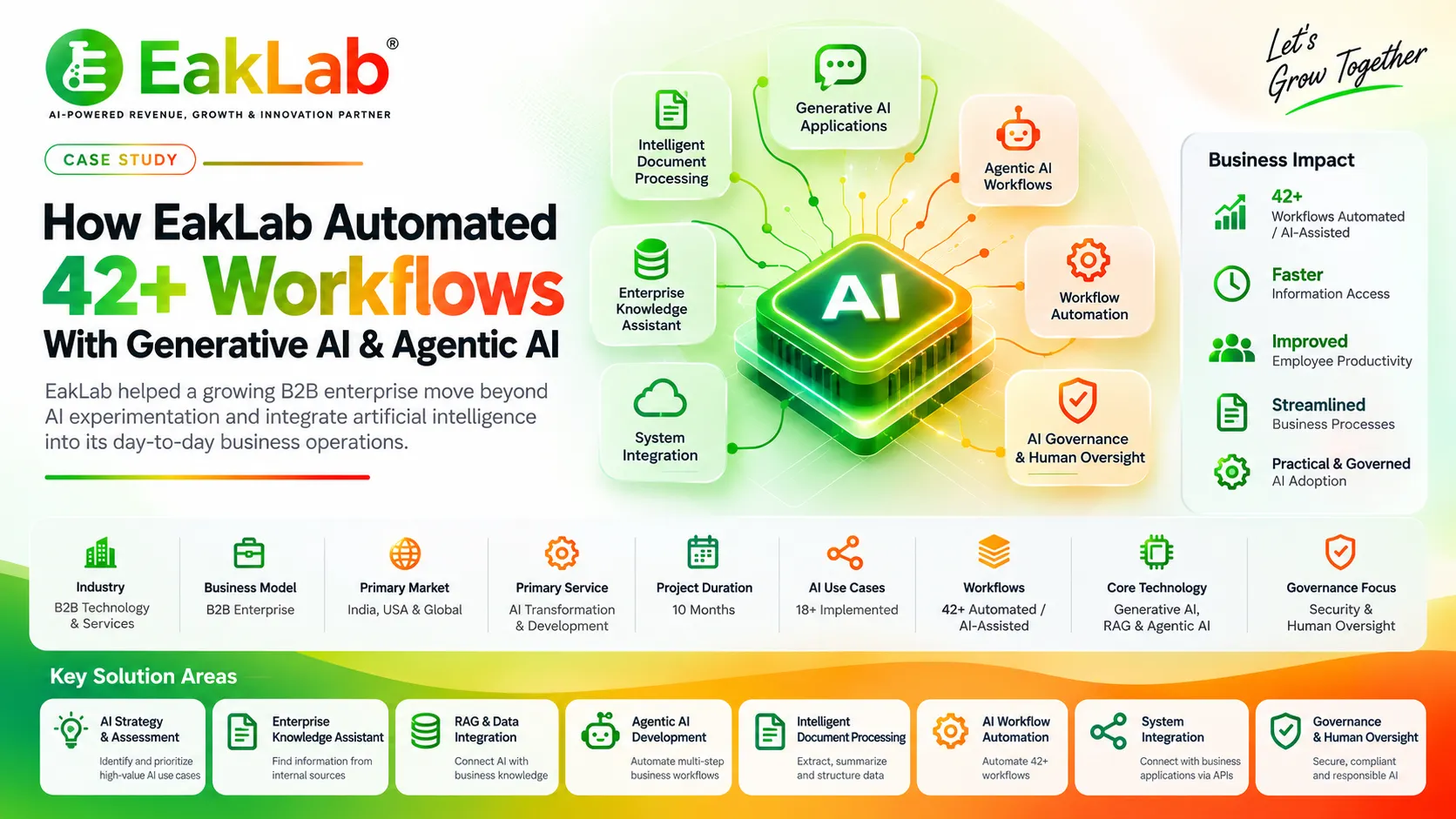

How EakLab Automated 42+ Workflows With Generative AI & Agentic AI
EakLab helped a growing B2B enterprise move beyond AI experimentation and integrate artificial intelligence into its day-to-day business operations.
Through a structured AI transformation initiative, EakLab combined Generative AI, Agentic AI, enterprise knowledge retrieval, intelligent document processing and workflow automation to improve productivity, accelerate information access and streamline repetitive business processes.
About the Client
The client was a growing B2B organization managing large volumes of customer interactions, operational information, documents, internal knowledge and business data across multiple systems.
As the organization expanded, employees spent considerable time on repetitive information-processing activities, customer queries, document analysis, internal research and operational workflows. Although the company had experimented with AI tools, it needed a structured approach to integrate AI into its core business processes.
EakLab was engaged to develop an AI transformation roadmap and implement a portfolio of AI solutions designed to improve productivity, information accessibility and operational efficiency.
The Challenge
1. Repetitive Knowledge Work
Employees spent significant time on research, content processing, information retrieval and documentation activities that could potentially be accelerated through AI-assisted workflows.
2. Fragmented Business Knowledge
Important information was distributed across documents, databases, applications and internal knowledge repositories, requiring employees to search multiple sources manually.
3. Manual Customer Support
Customer-facing teams handled substantial volumes of repetitive questions and information requests, creating opportunities for AI-assisted support and faster query resolution.
4. Limited AI Adoption
The organization had started experimenting with AI but lacked a structured implementation strategy for operational deployment and measurable business impact.
5. Data Accessibility
Business users needed faster access to relevant information from approved internal sources, with responses grounded in organizational knowledge.
6. Complex Workflows & Governance
Multi-step business processes increased processing time, while AI adoption required appropriate controls for data access, permissions, sensitive information, output review and human oversight.
The Solution
Building an Enterprise AI Transformation Framework: EakLab combined Generative AI applications, enterprise knowledge assistance, Agentic AI workflows, intelligent document processing, system integration and governance controls to connect AI capabilities with actual business requirements.
AI Transformation Assessment
Business processes, existing applications, data environments, customer workflows, knowledge repositories and AI readiness were assessed to prioritize use cases based on business value and technical feasibility.
Data & Knowledge Preparation
Relevant documents, business data and knowledge sources were identified and prepared for AI-powered applications while maintaining appropriate access controls.
Generative AI Applications
Business-specific AI capabilities supported natural-language queries, document summarization, content generation, information extraction, knowledge retrieval, business research, customer responses and employee assistance.
Enterprise Knowledge Assistant
An AI-powered knowledge assistant enabled employees to find information from approved internal sources using natural-language questions, contextual responses, document retrieval and summarization.
Retrieval-Augmented Generation (RAG)
Where appropriate, AI responses were connected with relevant business knowledge and approved information sources, allowing applications to use organizational context instead of relying exclusively on general model knowledge.
Agentic AI Development
AI agents supported multi-step workflows involving request understanding, information retrieval, analysis, approved actions, validation and responses, with access to business systems governed by workflow permissions.
AI-Powered Customer Support
AI capabilities supported query classification, knowledge retrieval, response generation, ticket assistance and information extraction, with human escalation available for requests requiring additional review.
Intelligent Document Processing
AI-powered document classification, data extraction, summarization, information validation and structured data creation reduced manual processing requirements and accelerated information handling.
AI Workflow Automation
More than 42 repetitive workflow activities were automated or converted into AI-assisted processes covering information retrieval, data processing, content preparation, customer communication, document handling and internal research.
AI & Business-System Integration
AI applications were connected with relevant business applications through APIs and integration workflows, enabling solutions to interact with approved business data and systems.
AI Governance & Human Oversight
Controls around data access, user permissions, sensitive information, output review, human escalation, monitoring and usage policies supported responsible AI adoption.
AI Performance Monitoring
AI applications were monitored against usage, response quality, workflow completion, processing time, error rates, employee adoption and cost-efficiency indicators to support continuous improvement.
Results: Measurable AI Transformation Impact
Ten-month transformation across AI adoption, productivity and workflow automation.
| Metric | Before | After | Improvement |
|---|---|---|---|
|
AI Use Cases
|
2 pilot projects | 18+ | +800% |
|
Automated Workflows
|
0 automated | 42+ | 42+ workflows |
|
Knowledge-Search Time
|
26 min/task | 7 min/task | 73% reduction |
|
Document-Processing Time
|
18 min/document | 5 min/document | 72% faster |
|
Customer-Query Resolution
|
14 minutes | 5 minutes | 64% faster |
|
Workflow-Processing Time
|
11 hours/week | 4.8 hours/week | 56% reduction |
|
AI Response Acceptance
|
68% | 91% | +23 percentage points |
|
Employee AI Adoption
|
18% | 76% | +58 percentage points |
|
AI-Assisted Employee Tasks
|
0% | 48% | 48% adoption |
|
AI-Assisted Support Requests
|
0% | 54% | 54% coverage |
42+ Workflows Automated
AI-powered knowledge retrieval, document processing and intelligent automation improved productivity while expanding enterprise AI adoption across business processes.
Business Outcomes
Automated 42+ Workflows
More than 42 repetitive activities were automated or converted into AI-assisted processes, reducing manual work across information retrieval, documentation, communication and operations.
Expanded AI Use Cases by 800%
The organization expanded from two initial AI pilot projects to more than 18 use cases, establishing a broader foundation for practical AI adoption.
73% Less Knowledge-Search Time
Average search time decreased from 26 minutes to seven minutes per task through AI-powered knowledge retrieval.
72% Faster Document Processing
Processing time decreased from 18 minutes to five minutes per document through AI-assisted classification, extraction, summarization and validation.
64% Faster Customer-Query Resolution
Average resolution time decreased from 14 minutes to five minutes, supporting faster handling of repetitive questions and information requests.
56% Less Workflow-Processing Time
Weekly processing requirements decreased from approximately 11 hours to 4.8 hours for selected workflows.
91% AI Response Acceptance
AI response acceptance increased from 68% to 91% following iterative optimization and improvements to business context.
76% Employee AI Adoption
Employee AI adoption increased from 18% to 76%, indicating broader use of AI-powered capabilities across the organization.
Performance at a Glance
Business Value Delivered
Productivity
Less repetitive work and faster access to relevant information through AI-assisted workflows.
Customer Experience
Faster responses and AI-assisted customer support for repetitive questions and information requests.
Operations
Automated workflows and reduced processing time across selected business processes.
Knowledge Management
AI-powered search and contextual information retrieval from approved organizational knowledge.
Technology
Generative AI, Agentic AI, APIs and enterprise application integration.
Innovation
Expanded AI use cases and intelligent automation capabilities aligned with business requirements.
EakLab’s AI Transformation Framework
01 — AI Readiness Assessment
Evaluate business processes, data, technology, AI maturity and transformation opportunities.
02 — Use-Case Discovery
Identify practical AI opportunities based on business value, feasibility, data availability and organizational requirements.
03 — Data & Knowledge Preparation
Prepare relevant business data, documents and knowledge sources for AI-powered applications.
04 — Generative AI Development
Build AI-powered applications for business processes, customer experiences and organizational knowledge.
05 — Agentic AI Development
Develop AI agents capable of supporting multi-step workflows and interacting with approved business systems.
06 — AI Integration
Connect AI applications with APIs, enterprise systems, databases and business workflows.
07 — Governance & Human Oversight
Establish controls around access, security, AI outputs, monitoring and human review.
08 — Continuous AI Optimization
Monitor usage, response quality, workflow performance and business impact while improving AI capabilities.
AI Transformation Lifecycle
Business Challenge → AI Opportunity → Data → AI Model → Agent / Application → Automation → Human Oversight → Business Impact
Why EakLab for AI Transformation & Development?
Business-First AI Strategy
Identify practical business opportunities where AI can create measurable value instead of adopting AI simply for experimentation.
Generative AI Development
Build customized AI applications around business processes, customer experiences and organizational knowledge.
Agentic AI
Develop AI agents that support multi-step workflows and interact with approved business systems.
AI-Powered Automation
Combine AI with workflow automation to reduce repetitive work and improve operational efficiency.
Enterprise AI Integration
Connect AI solutions with existing applications, APIs, databases and organizational knowledge.
AI Governance
Incorporate appropriate controls around data, access, outputs, security and human oversight.
Scalable AI Architecture
Design AI capabilities that can evolve as use cases, data volumes and business requirements grow.
Growth + Technology + Data + AI
Connect AI initiatives with broader digital transformation and business objectives through EakLab’s combined capabilities.
Related Posts: