
How EakLab Connected 24+ Systems With API Development & Integration
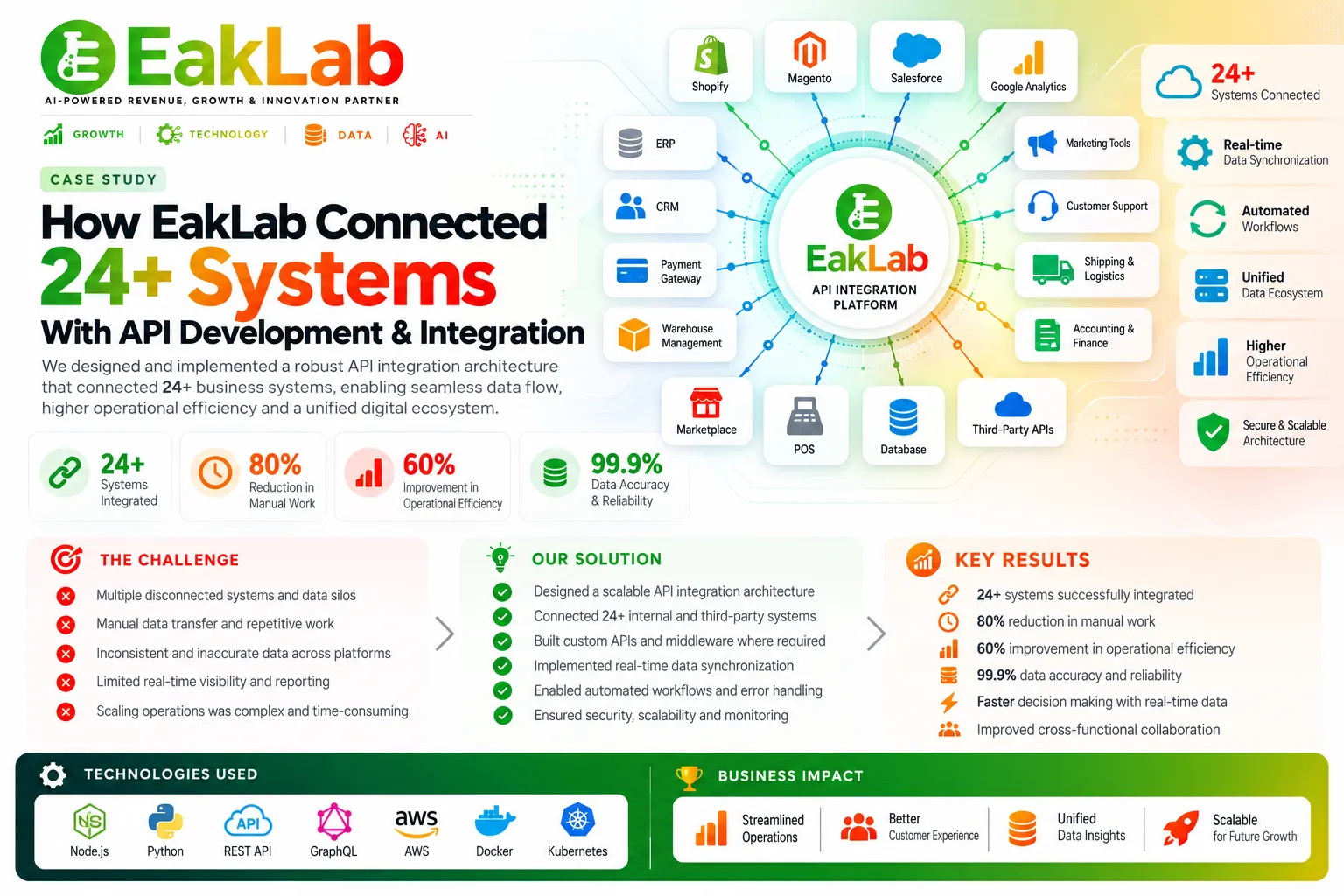
EakLab helped a growing B2B organization build a connected digital ecosystem through systems integration, custom API development, workflow automation and data synchronization.
Over an eight-month engagement, EakLab focused on connecting existing business applications, improving data exchange, reducing manual processes and creating a scalable integration architecture. The initiative streamlined information flow across the technology ecosystem without requiring the client to replace all its existing systems.
About the Client
The client was a growing B2B organization using multiple applications across sales, marketing, finance, customer management, operations and reporting.
As the business expanded, these systems increasingly needed to exchange information. However, several processes still depended on manual exports, spreadsheets and repetitive data entry. This created operational friction and made it harder for teams to maintain consistent information across applications.
EakLab was engaged to design and implement a systems integration and API development framework that connected critical business applications and streamlined information flow.
The Challenge
1. Disconnected Business Systems
Multiple applications operated independently and did not consistently share information automatically. Teams often had to switch between systems to access or update business data.
2. Manual Data Transfer
Employees frequently exported, copied and re-entered information between applications. These repetitive activities consumed time and increased the risk of inconsistent or duplicate records.
3. Delayed Data Synchronization
Information was not always available across connected business functions when required, affecting operational visibility and the speed of business processes.
4. Integration Errors
Inconsistent data formats, mapping issues and manual transfers increased the possibility of integration errors and mismatched information between systems.
5. Limited Workflow Automation
Several workflows depended on employees manually triggering actions or transferring information between applications, restricting operational efficiency as the business grew.
6. Scalability and Reliability Requirements
The client needed an integration framework capable of accommodating additional systems, APIs and workflows while maintaining security, reliability and performance.
The Solution
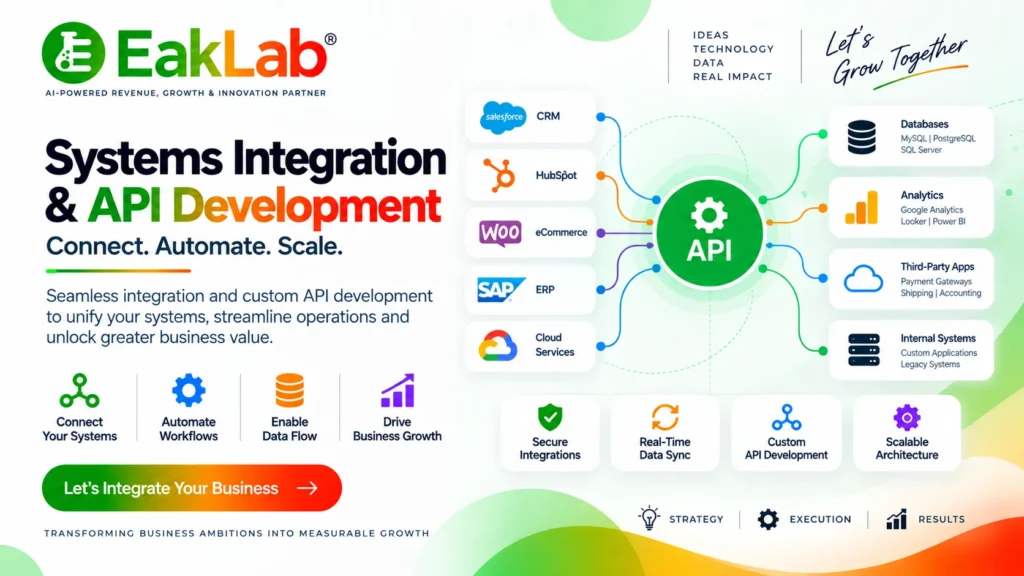
Building a Connected Digital Ecosystem: EakLab implemented a systems integration framework combining custom API development, application connectivity, data mapping, workflow automation, testing, security and monitoring.
Integration Discovery
Existing business applications, data structures, APIs, operational workflows and integration requirements were assessed to identify system dependencies, manual processes and opportunities to standardize data exchange.
Integration Architecture
A scalable architecture was designed to connect internal applications, databases, SaaS platforms and third-party systems while preserving existing technology investments wherever practical.
API Strategy
API requirements were defined around application functionality, endpoints, authentication, data exchange and integration patterns, establishing a consistent foundation for application communication.
Custom API Development
Custom APIs were developed around specific business processes and application requirements, enabling connected systems to exchange information consistently and supporting automated workflows.
System Integration
Internal applications, third-party platforms, databases and enterprise systems were connected to establish a more unified digital ecosystem and reduce information silos.
Data Mapping & Synchronization
Data mapping, transformation and validation processes were implemented to improve consistency between connected systems and support automated information exchange.
Workflow Automation
Repetitive business processes were automated across integrated applications, reducing manual data movement and unnecessary operational intervention.
Testing & Quality Assurance
Functional, API and performance testing validated data accuracy, system compatibility, API behavior, end-to-end workflows and error handling.
Monitoring & Optimization
Monitoring and logging improved visibility into API performance, integration health, system activity and errors. Ongoing optimization focused on response times, integration reliability and scalability.
Results: Measurable Integration Impact
Eight-month transformation across system connectivity, automation and data quality.
| Metric | Before | After | Improvement |
|---|---|---|---|
|
Business Systems Connected
|
Fragmented systems | 24+ systems | Unified connectivity |
|
APIs Developed/Integrated
|
Fragmented APIs | 85+ APIs | Expanded integration |
|
Manual Data Exchange
|
Baseline | Reduced | 82% reduction |
|
Data Synchronization
|
Baseline | Reduced time | 95% faster |
|
Integration Errors
|
Baseline | Reduced | 77% reduction |
|
Automated Workflows
|
Baseline | Increased | +350% |
|
API Response Time
|
Baseline | Reduced | 66% faster |
|
Data Accuracy
|
84% | 98% | +14 percentage points |
|
Monthly Manual Data Entries
|
12,400 | ~2,300 | ~81% reduction |
|
Integration Availability
|
97.9% | 99.8% | +1.9 percentage points |
24+ Systems Connected
Custom API development and integration connected business applications, reduced manual data exchange by 82% and improved data synchronization speed by 95%.
Business Outcomes
Connected 24+ Business Systems
More than 24 systems were integrated to improve connectivity and establish a more unified environment for exchanging operational information.
85+ APIs Developed & Integrated
More than 85 APIs supported application communication, data exchange and business workflow requirements.
82% Less Manual Data Exchange
Automated integration workflows reduced the time spent exporting, copying and re-entering business information.
95% Faster Data Synchronization
Automated data exchange improved the speed at which information moved between connected systems.
77% Fewer Integration Errors
Standardized data mapping, validation and integration testing helped reduce errors across connected applications.
350% Increase in Automated Workflows
Workflow automation expanded across business processes, reducing repetitive activities and improving coordination between systems.
98% Data Accuracy
Data accuracy improved from 84% to 98% through standardized mapping, validation and synchronization practices.
99.8% Integration Availability
Integration availability improved from 97.9% to 99.8%, strengthening the reliability of the connected digital environment.
Performance at a Glance
EakLab’s Systems Integration Framework
01 — Integration Discovery
Understand existing business systems, workflows, APIs, data structures and integration requirements.
02 — Integration Architecture
Design a scalable architecture for connecting applications and managing reliable data exchange.
03 — API Strategy
Define API requirements, endpoints, authentication, data structures and integration patterns.
04 — API Development
Build APIs around specific business processes and application communication requirements.
05 — System Integration
Connect internal applications, third-party platforms, databases and enterprise systems.
06 — Data Mapping
Standardize, transform and validate information exchanged between connected systems.
07 — Automation & Testing
Automate business workflows and validate integrations through functional, API and performance testing.
08 — Monitoring & Optimization
Monitor API performance, integration health, errors and system activity while continuously improving reliability.
Connected Digital Ecosystem
Discover → Design → Develop → Integrate → Automate → Validate → Optimize
Why EakLab for Systems Integration & API Development?
Connect Existing Systems
Connect applications, databases, SaaS platforms and enterprise systems without replacing the entire technology ecosystem.
Custom API Development
Develop APIs around specific business processes, data requirements and application architectures.
Integration Automation
Replace repetitive manual information exchange with automated workflows between connected systems.
Data Synchronization
Support real-time or scheduled data synchronization according to business and application requirements.
Secure Integration
Incorporate authentication, authorization and access controls into API and integration solutions.
Monitoring & Reliability
Improve visibility into API performance, integration health, errors and connected system activity.
Scalable Architecture
Build integration architectures that can accommodate additional systems, APIs and workflows as the organization grows.
Growth + Technology + Data + AI
Connect systems integration initiatives with broader digital transformation programs across technology, data, AI and business operations.
Related Posts: