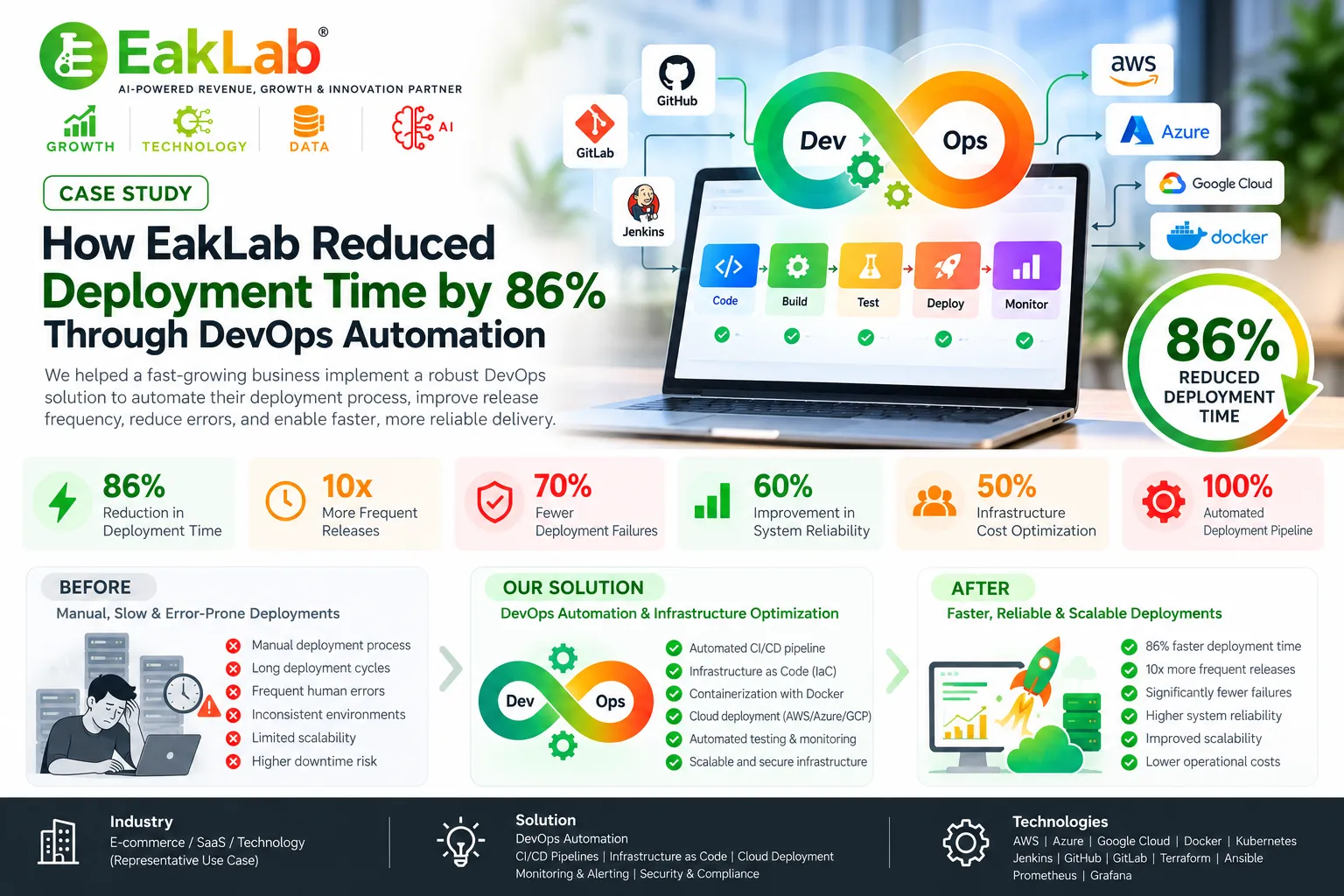

How EakLab Reduced Deployment Time by 86% Through DevOps Automation
EakLab helped a growing SaaS and technology company modernize its DevOps environment through CI/CD automation, cloud infrastructure optimization, Infrastructure as Code, centralized monitoring and integrated security practices.
The nine-month engagement focused on reducing deployment time, increasing release frequency, improving infrastructure reliability and minimizing manual operational dependencies. Automated delivery workflows and stronger monitoring established a more consistent and scalable software delivery process.
About the Client
The client was a growing SaaS and technology company seeking to modernize its software delivery processes and cloud infrastructure to support expanding engineering requirements.
Manual deployment activities, differences between environments and limited monitoring created operational dependencies and made releases more difficult to manage. The organization needed a structured DevOps framework that could improve deployment efficiency, infrastructure consistency and production reliability.
EakLab was engaged for a nine-month DevOps and cloud infrastructure modernization initiative focused on CI/CD automation, Infrastructure as Code, containerization, monitoring, security and continuous optimization across 14 applications.
The Challenge
1. Slow Deployment Cycles
Application deployments required approximately 3.5 hours, delaying releases and limiting the team’s ability to deliver product improvements quickly.
2. Manual and Repetitive Operations
The deployment process involved 32 manual steps, increasing operational effort and dependency on repetitive tasks.
3. Production Deployment Failures
A production deployment failure rate of 11.4% created additional troubleshooting and recovery work.
4. Limited Monitoring and Visibility
Monitoring covered only four applications, restricting visibility into application performance, infrastructure health and deployment status.
5. Slow Infrastructure Provisioning
Infrastructure provisioning took approximately 2.5 days, making it harder to prepare environments quickly as requirements changed.
6. Recovery and Rollback Challenges
A mean time to recovery of 3.8 hours and nine production rollbacks per month highlighted the need for more reliable releases and faster incident response.
The Solution
Building a Modern DevOps & Cloud Infrastructure Environment: EakLab implemented a structured transformation connecting development workflows, infrastructure operations, automated testing, monitoring and security through a more consistent software delivery lifecycle.
DevOps Assessment
Existing infrastructure, application environments, deployment processes and operational requirements were evaluated to identify opportunities for automation, consistency and reliability improvements.
Cloud & Infrastructure Strategy
Infrastructure requirements were reviewed to support application growth, changing workloads, scalable environments and improved resource visibility and management.
CI/CD Pipeline Implementation
Continuous Integration and Continuous Deployment workflows automated application builds, testing, validation and deployment, reducing repetitive manual work and enabling more frequent releases.
Infrastructure as Code
Infrastructure provisioning and configuration were progressively automated to improve repeatability, configuration consistency, environment management and provisioning speed.
Containerization
Where appropriate, applications were containerized to improve consistency across development, testing and production environments and simplify application packaging.
Deployment Automation
Deployment workflows were redesigned across development, staging and production environments to reduce manual dependencies and establish more predictable release procedures.
Monitoring & Observability
Centralized monitoring covered application performance, infrastructure health, resource utilization, deployment status, availability, error rates and system alerts.
Security Integration
Access management, secrets management, vulnerability checks, secure deployment practices and infrastructure controls were integrated into the broader DevOps workflow.
Automated Testing
Relevant unit, integration, API and regression tests, along with deployment validation, were incorporated into CI/CD workflows to improve release confidence and identify issues before production.
Infrastructure Scaling & Optimization
Infrastructure optimization focused on application workloads, increasing traffic, resource utilization, deployment performance, system reliability and operational efficiency.
Results: Measurable DevOps Impact
Nine-month transformation across deployment efficiency, automation and reliability.
| Metric | Before | After | Improvement |
|---|---|---|---|
|
Deployment Time
|
3.5 hours | 29 minutes | 86% faster |
|
Deployment Frequency
|
12/month | 46/month | +283% |
|
Manual Deployment Steps
|
32 | 7 | 78% reduction |
|
Production Deployment Failures
|
11.4% | 3.1% | 73% reduction |
|
Mean Time to Recovery
|
3.8 hours | 58 minutes | 75% faster |
|
Infrastructure Provisioning
|
2.5 days | 3.2 hours | 95% faster |
|
System Availability
|
98.6% | 99.85% | +1.25 percentage points |
|
Automated Test Coverage
|
41% | 84% | +43 percentage points |
|
Monitored Applications
|
4 | 14 | +250% |
|
Production Rollbacks
|
9/month | 2/month | 78% reduction |
86% Faster Deployments
Improved delivery speed, increased release frequency and more reliable infrastructure operations across 14 supported applications.
Business Outcomes
86% Faster Deployments
Average deployment time decreased from 3.5 hours to 29 minutes through CI/CD automation and streamlined release workflows.
283% Increase in Deployment Frequency
Monthly deployments increased from 12 to 46, enabling the product team to release improvements more frequently.
78% Reduction in Manual Steps
Manual deployment steps decreased from 32 to 7, reducing repetitive operational activities and manual intervention.
73% Fewer Deployment Failures
Production deployment failure rates declined from 11.4% to 3.1%, supporting more predictable releases.
75% Faster Recovery
Mean time to recovery improved from 3.8 hours to 58 minutes through better monitoring and operational visibility.
95% Faster Infrastructure Provisioning
Provisioning time decreased from approximately 2.5 days to 3.2 hours, enabling faster environment preparation.
99.85% System Availability
Availability improved from 98.6% to 99.85%, strengthening service reliability and application consistency.
78% Fewer Release Rollbacks
Production rollbacks decreased from nine to two per month through improved testing, standardized deployments and release validation.
Performance at a Glance
Business Value Delivered
Development
Faster releases and automated delivery workflows that improve software delivery efficiency.
Infrastructure
More consistent, scalable and repeatable infrastructure management and provisioning.
Operations
Improved monitoring, stronger visibility and faster incident recovery.
Security
Integrated security checks, access controls and safer deployment practices.
Quality
Greater automated test coverage and fewer production deployment failures.
Business
Improved product delivery velocity and more reliable digital services.
EakLab’s DevOps Framework
01 — Assess
Evaluate existing applications, infrastructure and delivery workflows to identify improvement opportunities.
02 — Plan
Develop a cloud and infrastructure strategy aligned with application and operational requirements.
03 — Automate
Implement CI/CD pipelines and Infrastructure as Code to reduce manual effort and accelerate delivery.
04 — Standardize
Improve environment consistency through suitable containerization and configuration practices.
05 — Monitor
Establish centralized monitoring, logging, alerting and observability across applications and infrastructure.
06 — Secure
Integrate access controls, secrets management and vulnerability checks into delivery workflows.
07 — Validate
Automate relevant testing and deployment validation to improve release confidence.
08 — Optimize
Continuously improve infrastructure performance, reliability and resource efficiency.
Continuous DevOps Lifecycle
Code → Automate → Test → Deploy → Monitor → Optimize → Scale
Why EakLab for DevOps Services?
Faster Software Delivery
Automate the path from code development to production deployment, supporting more frequent and consistent releases.
CI/CD Automation
Reduce repetitive manual activities and improve release efficiency through automated delivery pipelines.
Cloud & Infrastructure Modernization
Support scalable application environments and more consistent infrastructure management.
Infrastructure as Code
Use repeatable, version-controlled configurations to improve provisioning speed and environment consistency.
Monitoring & Observability
Improve visibility into application and infrastructure health to identify issues and respond to operational changes.
DevSecOps Integration
Integrate security controls into development, deployment and infrastructure workflows.
Scalable Architecture
Prepare infrastructure for changing workloads, growing application demand and future business expansion.
Technology, Data & AI
Connect DevOps initiatives with EakLab’s broader capabilities across technology, data, AI and software engineering transformation.
Related Posts: