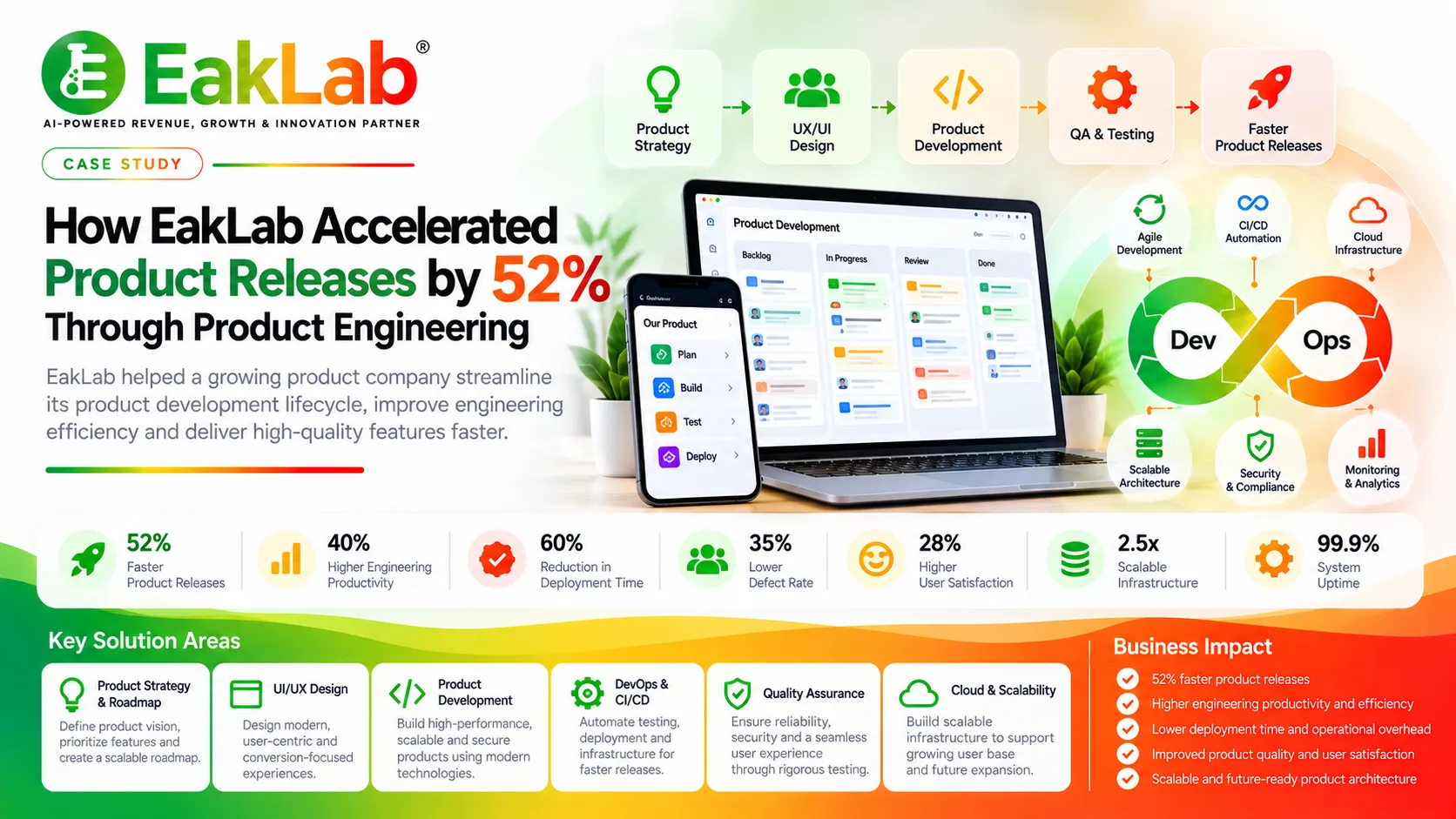

How EakLab Accelerated Product Releases by 52% Through Product Engineering
Transforming an ecommerce website into a more efficient digital commerce platform through better product discovery, a smoother checkout experience, mobile performance, system integrations and customer retention.
About the Client
The client was an ecommerce and direct-to-consumer business managing a large product catalog and serving customers through digital channels. As the business grew, its ecommerce experience needed to support better product discovery, smoother checkout, improved mobile usability and more efficient coordination between commerce operations.
The goal was to build a scalable ecommerce platform supporting the complete customer journey—from browsing products to purchasing and returning for future orders.
EakLab combined ecommerce development with user experience, performance optimization, integrations and analytics to create a stronger digital commerce foundation.
The Challenge
The existing shopping journey presented opportunities to improve discovery, conversion, mobile usability and commerce operations.
1. Product Discovery Friction
Customers needed a clearer, more convenient way to browse and evaluate products.
2. Low Conversion Efficiency
The platform needed to convert a greater proportion of existing visitors into customers.
3. Cart & Checkout Drop-Offs
Friction during the purchase journey contributed to customers leaving before completing orders.
4. Mobile Conversion Gaps
Smartphone users needed a faster, more intuitive shopping experience.
5. Performance Limitations
Slow page loading affected the overall shopping experience.
6. Limited Repeat Purchases
The business needed to strengthen retention and encourage repeat buying.
7. Disconnected Operations
Product, inventory, payments, orders, logistics and customer information needed to work in a more connected commerce environment.
The Solution
EakLab approached the project as an end-to-end ecommerce development initiative, combining storefront development, customer experience improvements, integrations, performance optimization and conversion tracking.
Product Catalog & Discovery
Improved product browsing, search, product information and navigation across a catalog of 8,500+ SKUs.
Customer Experience & Conversion
Simplified product evaluation, cart interactions and the steps customers take before completing a purchase.
Mobile Commerce
Optimized navigation, browsing, cart, checkout and account functionality for smartphone users and other devices.
Commerce Integrations
Connected relevant payment, inventory, order-management, customer, logistics and fulfilment systems.
Performance & Analytics
Improved page speed and tracked product views, searches, add-to-cart events, checkout starts and purchases.
Implementation & Execution
Phase 1 — Ecommerce Discovery
Understood the client’s products, customers, business objectives, technology environment and operational requirements to define platform priorities.
Phase 2 — UX & Conversion Strategy
Evaluated product discovery, customer trust, cart interactions and checkout completion to reduce friction at key decision points.
Phase 3 — Ecommerce Development
Developed the storefront, product catalog, customer accounts, shopping cart and checkout functionality to support the catalog and evolving requirements.
Phase 4 — Payment & System Integrations
Addressed payments, inventory, order management, customer records, logistics, fulfilment and notifications for a more coordinated commerce ecosystem.
Phase 5 — Customer Accounts & Order Tracking
Supported profile management, order history and status, tracking information, saved addresses and communication preferences.
Phase 6 — Mobile Commerce Optimization
Optimized navigation, product browsing, search, product pages, cart, checkout and account management across devices.
Phase 7 — Analytics & Conversion Tracking
Tracked product views, searches, add-to-cart actions, checkout starts, purchases, customer journeys, campaign traffic and revenue.
Phase 8 — Performance Optimization
Focused on page loading, images, frontend assets, code efficiency, mobile performance, caching, database queries and third-party scripts.
Phase 9 — Testing & Launch
Tested desktop, mobile and tablet journeys, browsers, product flows, cart, checkout, payments, APIs, inventory, order processing and tracking before deployment.
Results: Measurable Ecommerce Growth
The reference document provides the following before-and-after metrics.
Monthly Orders
10,080 → 25,010
Conversion Rate
2.4% → 4.1%
Website Traffic
420,000 → 610,000 monthly visitors
Average Order Value
₹2,450 → ₹2,780
Cart Abandonment
72% → 54%
Mobile Conversion
1.7% → 3.5%
Page Loading
5.4 sec → 1.8 sec
Repeat Purchase Rate
18% → 29%
Detailed Performance Metrics
| KPI | Before | After | Reported Improvement |
|---|---|---|---|
| Monthly website visitors | 420,000 | 610,000 | +45% |
| Ecommerce conversion rate | 2.4% | 4.1% | +71% |
| Monthly orders | 10,080 | 25,010 | +148% |
| Average order value | ₹2,450 | ₹2,780 | +13% |
| Cart abandonment rate | 72% | 54% | 25% reduction |
| Checkout completion rate | 58% | 79% | +36% |
| Mobile conversion rate | 1.7% | 3.5% | +106% |
| Average session duration | 2m 06s | 3m 41s | +75% |
| Average page-load time | 5.4 sec | 1.8 sec | 67% faster |
| Repeat purchase rate | 18% | 29% | +61% |
Business Outcomes
Higher Ecommerce Conversion
Conversion rate increased from 2.4% to 4.1%, improving the proportion of visitors who completed purchases.
More Monthly Orders
Monthly orders increased from 10,080 to 25,010, a reported increase of approximately 148%.
Higher Average Order Value
Average order value increased from ₹2,450 to ₹2,780. The reference document associates this with improved discovery and cross-selling opportunities.
Lower Cart Abandonment
Cart abandonment declined from 72% to 54%, indicating less friction in the shopping journey.
Improved Checkout Completion
Checkout completion increased from 58% to 79%, supporting a smoother purchase experience.
Stronger Mobile Commerce
Mobile conversion increased from 1.7% to 3.5%.
Faster Shopping Experience
Average page-load time fell from 5.4 seconds to 1.8 seconds.
Improved Customer Retention
Repeat purchase rate increased from 18% to 29% in the reference scenario.
Revenue Impact & Business Value
Using the reference monthly order and average order value figures:
BEFORE
₹2.47 crore
10,080 monthly orders × ₹2,450 average order value
AFTER
₹6.95 crore
25,010 monthly orders × ₹2,780 average order value
CALCULATED DIFFERENCE
≈ ₹4.48 crore
Additional monthly gross order value based on the reference figures
Customer Experience
A simpler, faster and more convenient shopping journey.
Conversion
Improved product discovery and less friction in cart and checkout.
Revenue Potential
More orders and a higher average order value.
Retention
Better customer experience and more repeat purchases.
Operations
Better connectivity across inventory, orders, payments and logistics.
Technology
A more scalable, integrated and maintainable commerce platform.
EakLab’s Ecommerce Development Framework
1. Ecommerce Discovery
Understand products, customers, business objectives, technology and operational requirements.
2. UX & Conversion Strategy
Structure the shopping journey around product discovery, trust, checkout and conversion.
3. Ecommerce Development
Build the storefront, product catalog, customer accounts, cart and checkout functionality.
4. Integrations
Connect payments, inventory, CRM, ERP, logistics, analytics and other business systems.
5. Performance & Security
Optimize the platform for speed, reliability, scalability and secure transactions.
6. Testing & Launch
Validate the complete customer and operational journey before deployment.
7. Analytics & Optimization
Measure customer behaviour, conversion and revenue performance, then continuously improve the platform.
Why EakLab for Ecommerce Development?
Customer-Centric Commerce
Build ecommerce experiences around how customers discover, evaluate and purchase products.
Conversion-Focused Development
Reduce friction across product discovery, cart and checkout to improve the shopping experience.
Scalable Product Architecture
Support expanding product catalogs, website traffic, customers and transaction volumes.
Omnichannel Integrations
Connect ecommerce platforms with relevant payment, CRM, ERP, inventory, logistics and marketing systems.
Mobile Commerce
Create mobile-first experiences for customers using smartphones, tablets and desktop devices.
Data & Analytics
Connect customer behaviour with business outcomes to establish a foundation for continuous optimization.
Growth + Technology + Data + AI
Combine ecommerce development with marketing, analytics, automation and AI capabilities to support broader digital growth objectives.
Related Posts: