![EakLab [Official]](https://www.eaklab.com/wp-content/uploads/2026/09/EakLab-Logo-Latest.png)
EakLab Tech Stack | AI, Cloud, Data & Technology
At EakLab, technology is not about collecting a long list of programming languages, frameworks, platforms, or tools. It is about choosing the right technology to solve the right business problem.
As an AI-powered Revenue, Growth & Innovation company, EakLab brings together Growth, Engineering, Data, and AI to help businesses build digital products, connect systems, use data effectively, adopt artificial intelligence, and create scalable digital capabilities.
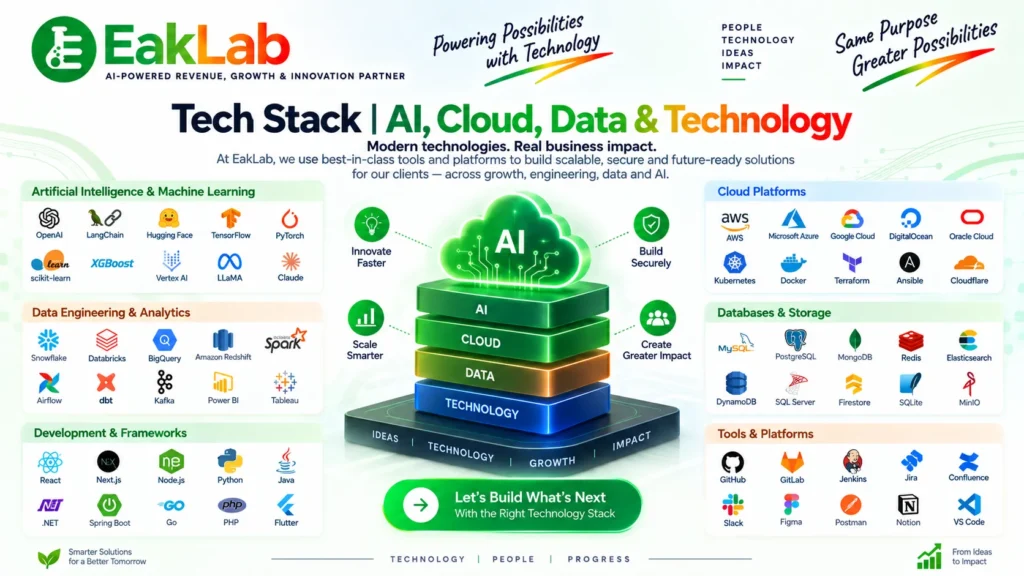
Every project has different requirements. A corporate website may need a very different architecture from a SaaS platform. An ecommerce business may have different technology needs from a mobile application, data warehouse, enterprise integration project, or AI agent.
That is why EakLab follows a business-first technology approach. Technology choices are considered around business objectives, application architecture, performance, scalability, security, integration requirements, maintainability, and long-term needs.
A Capability-Led Technology Ecosystem
EakLab’s technology ecosystem spans multiple layers of modern digital development. Instead of treating each layer as an independent technology function, the approach connects them to create complete and scalable solutions.
The overall architecture can be understood as:
Business Requirements → Product / Solution → Frontend + Backend + Mobile → APIs & Integration → Database + Data → Cloud → DevOps → AI → Business Outcomes
This structure allows technology decisions to remain connected to the purpose of the project rather than being driven by technology trends alone.
Programming Languages
Programming languages provide the foundation for websites, applications, software platforms, APIs, data systems, and AI solutions.
The client’s technology documentation identifies potential technology categories including:
- JavaScript
- TypeScript
- Python
- Java
- C#
- .NET
- PHP
- Go
However, these are documented as potential technology categories, not a declaration that every technology is currently used by EakLab. The final published technology list should contain only technologies that EakLab has actually confirmed.
The choice of language can depend on the project’s requirements, architecture, performance expectations, scalability, security, maintainability, existing technology environment, team expertise, and long-term business objectives.
Frontend Development Technologies
The frontend is the part of a digital product that customers, employees, or other users interact with directly. A well-designed frontend needs to be responsive, accessible, intuitive, and capable of delivering a consistent experience across devices.
Potential frontend technologies identified in EakLab’s documentation include:
- React
- Next.js
- Angular
- Vue.js
- JavaScript
- TypeScript
- HTML
- CSS
- UI component frameworks
- Responsive design technologies
These technologies can support different digital experiences, including corporate websites, B2B websites, SaaS applications, ecommerce storefronts, customer portals, enterprise applications, web applications, and AI-powered interfaces.
The objective is straightforward: create digital experiences that are fast, accessible, responsive, and scalable.
Backend Technologies
Behind every reliable digital product is a backend responsible for business logic, APIs, authentication, data processing, integrations, and application infrastructure.
Potential backend technologies and architecture categories in the EakLab documentation include:
- Node.js
- Python
- Java
- .NET
- PHP
- Go
- Backend frameworks
- REST APIs
- GraphQL
- Microservices
- Server-side architectures
Backend systems can support SaaS platforms, ecommerce systems, mobile applications, enterprise applications, APIs, data processing, AI applications, and third-party integrations.
For EakLab, the focus is on developing backend systems that are secure, reliable, scalable, and aligned with the needs of the business.
Mobile Application Technologies
Mobile applications are an important part of the modern digital ecosystem. Depending on the product and business requirements, applications may need to support Android, iOS, or cross-platform environments.
Potential mobile technologies documented by EakLab include:
- Native Android development
- Native iOS development
- React Native
- Flutter
- Kotlin
- Swift
- Mobile application frameworks
- Mobile APIs
- Mobile analytics
- Push notification technologies
These technologies can support consumer applications, enterprise applications, ecommerce applications, customer portals, business applications, SaaS mobile applications, and AI-enabled mobile experiences.
The technology choice depends on the application’s functionality, performance requirements, scalability expectations, user experience, and broader product architecture.
Databases & Data Storage
Data is at the center of almost every modern business application. Applications need reliable ways to store, retrieve, protect, and manage customer, transaction, product, operational, and business information.
Potential database and storage technologies listed in the documentation include:
- PostgreSQL
- MySQL
- Microsoft SQL Server
- MongoDB
- Redis
- Relational databases
- NoSQL databases
- Cloud databases
- Data storage platforms
These technologies can support web applications, mobile applications, ecommerce platforms, SaaS products, enterprise applications, analytics systems, and AI applications.
The goal is not simply to select a database. It is to create a reliable, secure, and scalable data architecture that fits the application and business requirements.
Data Engineering & Analytics
Data is one of EakLab’s four core pillars alongside Growth, Engineering, and AI.
Modern businesses often have data spread across marketing platforms, CRM systems, ecommerce platforms, ERP systems, applications, payment systems, and other sources. Connecting and organizing this information can create a stronger foundation for analytics and decision-making.
EakLab’s broader data capabilities include:
- Data Pipelines
- ETL / ELT
- Data Integration
- Data Transformation
- Data Warehouses
- Data Lakes
- Business Intelligence
- Analytics
- Dashboards
- Data-driven insights
The overall journey can be represented as:
Business Systems → Data Integration → Data Platform → Analytics → Insights → Decisions
This approach can help organizations create unified business information, improve reporting, support cross-functional analytics, and establish data foundations for AI.
Cloud & DevOps
Cloud infrastructure provides the foundation required to host applications, APIs, databases, data platforms, and AI workloads.
Potential cloud capabilities can include:
- Application hosting
- Databases
- APIs
- Data platforms
- Storage
- Computing
- AI workloads
- Monitoring
- Security infrastructure
DevOps supports deployment, automation, reliability, and the ongoing operation of digital systems.
Potential DevOps technology categories include Docker, Kubernetes, Terraform, and CI/CD, as identified in the client’s technology-stack reference. These should be treated as technologies to verify before being presented as confirmed EakLab production technologies.
The broader objective is to create infrastructure that can support reliable applications and scale alongside business requirements.
APIs & Systems Integration
Modern businesses rarely operate with one application or platform. Different systems need to communicate, exchange information, and trigger workflows.
EakLab works across integration concepts such as:
- REST APIs
- GraphQL
- Webhooks
- API gateways
- Third-party APIs
- Microservices
- Authentication and authorization
- Data integration
- Event-driven integrations
Potential integration environments include:
CRM ↔ ERP ↔ Ecommerce ↔ Payments ↔ Marketing ↔ Data ↔ Applications ↔ AI
The objective is to connect systems, improve data flow, reduce technology silos, and enable more efficient workflows.
AI, Generative AI & Agentic AI
Artificial intelligence represents an important part of EakLab’s technology direction.
Rather than presenting AI as simply a collection of AI brands or models, EakLab’s documentation focuses on capabilities such as:
- Generative AI
- Large Language Models
- Multimodal AI
- AI Applications
- AI Assistants
- AI Copilots
- AI Agents
- Agent orchestration
- Retrieval-Augmented Generation (RAG)
- Vector databases
- Embeddings
- Semantic search
- Intelligent automation
- AI integrations
- Machine learning models
These capabilities can support AI-powered applications, enterprise knowledge retrieval, conversational experiences, intelligent search, document intelligence, predictive analytics, recommendation systems, forecasting, and workflow automation.
EakLab’s AI philosophy is business-first, practical, connected, responsible, and scalable. AI should begin with a genuine business problem and should be connected to existing applications, data, and business systems where appropriate.
Technology That Works Together
The real strength of a technology stack comes from how its different layers work together.
For example:
Frontend → Backend → APIs → Database → Data → Cloud → DevOps → AI
A business may begin with a website or application, connect it to its CRM and ecommerce platform, move relevant information into a data platform, use analytics to understand performance, and then introduce AI or automation where it can create additional value.
This is where EakLab’s four-pillar model becomes important:
Growth + Engineering + Data + AI
Growth creates customer opportunities. Engineering builds digital products and systems. Data provides intelligence for better decisions. AI adds intelligence, automation, and new capabilities across the ecosystem.
Why EakLab Takes a Flexible Technology Approach
There is no single technology stack that is ideal for every business.
A corporate website, SaaS platform, ecommerce business, mobile application, enterprise integration project, data warehouse, and AI agent can all require very different architectures.
That is why EakLab’s technology philosophy is based on selecting the appropriate technology for the specific business problem.
The key considerations include:
- Business objectives
- Technical requirements
- Application architecture
- Performance
- Scalability
- Security
- Integration requirements
- Maintainability
- Existing technology environment
- Long-term business needs
This helps avoid a one-size-fits-all approach and keeps technology decisions focused on creating useful, sustainable business capabilities.
Technology Built Around Business Outcomes
Technology is only valuable when it helps a business move forward.
At EakLab, the technology ecosystem is designed to support the broader goals of Growth, Engineering, Data, and AI:
Growth: Marketing → Analytics → Attribution → Automation → AI Visibility
Engineering: Web → Mobile → Software → Ecommerce → Products
Data: Data Sources → Pipelines → Warehouses → Analytics → Intelligence
AI: LLMs → RAG → Agents → Automation → AI Transformation
The result is a technology approach focused on helping businesses build digital products, connect systems, understand their data, adopt AI, improve efficiency, and create scalable business solutions.
At EakLab, the goal is not to use technology for technology’s sake. The goal is to choose and connect the right capabilities to solve real business challenges and create measurable, sustainable outcomes.
Build smarter. Connect better. Use data effectively. Adopt AI practically. Scale with confidence.