![EakLab [Official]](https://www.eaklab.com/wp-content/uploads/2026/09/EakLab-Logo-Latest.png)
EakLab Process | Our Approach to Growth & Technology
At EakLab, we believe good digital transformation starts with understanding the business, not with choosing a technology, launching a campaign, or adding AI simply because it is available.
Every business has different goals, customers, systems, challenges, and opportunities. That is why our process is designed to begin with the bigger picture and then move step by step toward practical execution.
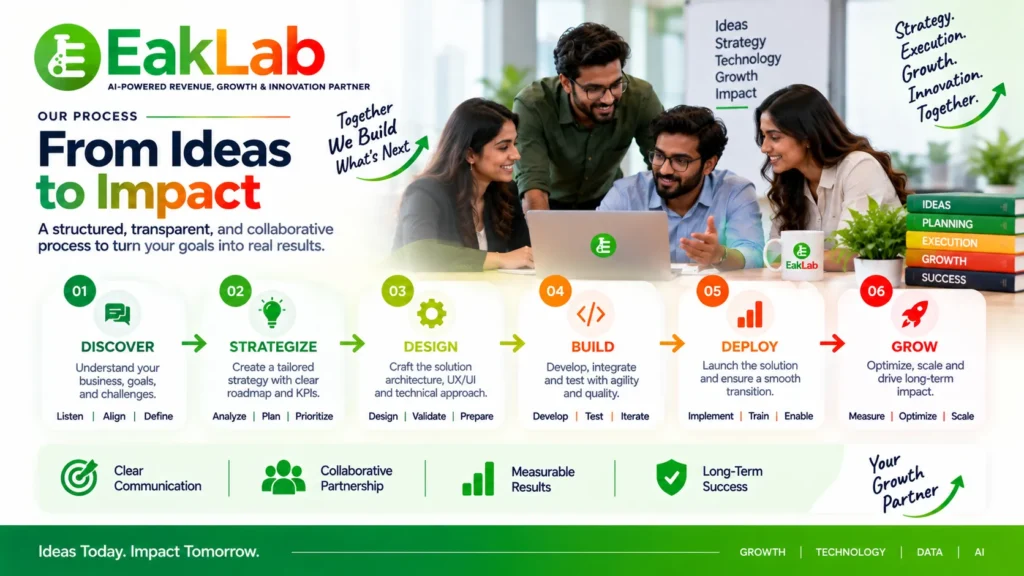
Our approach brings together Growth, Engineering, Data, and AI to help businesses acquire customers, build digital products, connect technology, make better decisions, automate processes, and scale with confidence.
Our process can be summarized as:
Discover → Diagnose → Strategize → Build → Integrate → Launch → Optimize → Scale
This framework gives every initiative a clear direction while keeping the focus on measurable and sustainable business outcomes.
01. Discover – Understand Before We Build
The first step in our process is understanding where your business stands today.
Before recommending a solution, we take the time to understand your business objectives, customers, products or services, existing technology, data environment, marketing ecosystem, operational processes, and growth challenges.
This matters because the right solution depends on the problem.
For example, a business may think it needs a new website when the bigger challenge is conversion. Another company may want an AI solution when the real opportunity is improving its data foundation first.
Discovery helps us understand the complete picture.
We ask questions such as:
- What are you trying to achieve?
- Who are your customers?
- What is currently working?
- Where are the biggest challenges?
- What technology and systems are already in place?
- How is business data being collected and used?
- Where are growth opportunities being missed?
- Which processes could be improved or automated?
The goal is simple: establish a clear understanding of the current state before deciding what comes next.
02. Diagnose – Find the Real Opportunities
Once we understand the business, we look deeper.
The Diagnose stage focuses on identifying gaps, limitations, inefficiencies, and opportunities across the business. This can include technology limitations, growth opportunities, data challenges, operational inefficiencies, customer experience gaps, and potential AI opportunities.
We do not look at these areas independently.
Growth may depend on better data. A software platform may need stronger APIs and integrations. An AI application may require better data infrastructure. An ecommerce business may need improvements across marketing, technology, analytics, and customer experience.
By looking at these connections, we can identify where improvements can have the greatest business impact.
The outcome of this stage is a clearer understanding of what needs to change, why it matters, and where the biggest opportunities exist.
03. Strategize – Build a Clear Roadmap
After discovery and diagnosis comes strategy.
At this stage, we turn insights into an actionable roadmap. The strategy can cover business priorities, growth strategy, technology architecture, data requirements, AI opportunities, implementation priorities, KPIs, and success measures.
A good strategy should answer more than what should we do?
It should also answer:
Why are we doing it? What should happen first? How will we measure success? What technology is required? What can be improved later?
This prevents businesses from investing in disconnected initiatives without a clear direction.
Whether the project involves digital marketing, website development, custom software, data engineering, systems integration, or AI transformation, we work toward creating a practical roadmap aligned with the organization’s objectives.
04. Build – Turn Strategy Into Reality
Once the roadmap is clear, we move into execution.
Depending on the business requirement, the Build stage may involve work across Growth, Engineering, Data, and AI. This could include marketing campaigns, websites, applications, software platforms, data pipelines, analytics systems, APIs, AI applications, AI agents, or automation workflows.
The important part is that development is connected to the strategy created earlier.
Our engineering capabilities cover areas such as web development, mobile app development, custom software development, ecommerce development, and product engineering. Data initiatives can include data pipelines, analytics, business intelligence, and data integration. AI initiatives can include Generative AI, Agentic AI, AI applications, and intelligent automation.
The result is not technology for technology’s sake. The objective is to build something useful, scalable, and relevant to the business.
05. Integrate – Connect What Already Exists
Building a new solution is only part of the job.
Most modern businesses already use multiple systems, platforms, applications, and data sources. A new website, application, AI solution, or data platform should not become another isolated system.
That is why integration is a dedicated stage in our process.
EakLab can work across ecosystems involving:
CRM ↔ Ecommerce ↔ ERP ↔ Data ↔ Marketing ↔ AI
Integration capabilities can include APIs, CRM integrations, ERP integrations, ecommerce integrations, payment systems, data platforms, third-party applications, AI systems, and workflow automation.
The objective is to improve connectivity, data flow, and operational efficiency while reducing technology silos.
06. Launch – Put the Solution Into the Real World
A solution is only valuable when it works in the real business environment.
During the Launch stage, the focus can include testing, deployment, training, integration, monitoring, and performance measurement.
This stage helps move a project from development into practical use.
For a website or application, that may mean preparing the platform for users and monitoring its performance. For a data or AI initiative, it may involve ensuring the solution works with the organization’s existing systems and workflows.
The goal is a controlled transition from build to business use.
07. Optimize – Improve With Data and Feedback
Launching does not mean the work is finished.
Once a solution is operating, we look at real-world performance and identify opportunities for improvement.
Optimization can focus on:
- Technology performance
- Customer experience
- Campaign efficiency
- Operational workflows
- AI effectiveness
- Business performance
- Overall outcomes
EakLab’s process uses data and continuous feedback to improve the solution after launch.
This is especially important for digital growth, software products, data systems, and AI applications because user behavior, business requirements, and market conditions can change over time.
Instead of treating a project as a one-time delivery, we view improvement as an ongoing part of building better business capabilities.
08. Scale – Grow What Works
When an initiative demonstrates value, the next question is how to scale it.
Successful solutions may be expanded across products, customers, markets, business functions, technology systems, or AI use cases.
Scaling does not always mean simply doing more of the same thing. It can mean improving infrastructure, expanding automation, connecting additional systems, extending a product, applying insights to new business areas, or introducing AI into additional workflows.
The objective is to help businesses build capabilities that can evolve as they grow.
One Connected Process, Not Isolated Services
One of the key differences in EakLab’s approach is that our capabilities are designed to work together.
A business may begin with a growth challenge and discover a data problem. A product development project may reveal integration requirements. An AI initiative may require engineering and data capabilities.
These areas are connected.
Our broader model brings together:
Growth → Data → Engineering → AI → Business Outcomes
Growth helps create demand and customer opportunities. Data provides the intelligence needed to understand performance. Engineering builds and connects the digital products and systems required to execute and scale. AI adds intelligence, automation, and advanced capabilities across growth, technology, data, and operations.
This integrated model allows businesses to approach transformation as a connected journey rather than a collection of unrelated projects.
Why Our Process Works
A structured process gives businesses clarity.
Instead of jumping directly into execution, we first understand the business, identify the real challenges, create a roadmap, build the right solution, connect it with existing systems, launch it, measure performance, and improve what works.
This approach helps connect business objectives with strategy, technology, data, execution, and continuous improvement.
Most importantly, the process remains flexible enough to support different types of businesses and different requirements. A company looking for digital growth may need a different path from a business building an AI application or modernizing its technology infrastructure.
The framework stays consistent while the solution is shaped around the business.
Let’s Start With Your Business Challenge
You do not need to have every answer before speaking with us.
If you know that your business needs better digital growth, a new product, stronger technology, connected systems, better data, automation, or practical AI adoption, we can start by understanding where you are today.
From there, we can identify the opportunities, define priorities, and create a practical path forward.
Discover the opportunity. Build the right solution. Connect the ecosystem. Measure the outcome. Scale what works.